Khawaja Asif: Marka-e-Haq Victory Lifted Pakistan's Prestige, He Tells Sialkot Convocation

Defence Minister Khawaja Asif told a university convocation in Sialkot on Saturday 31 October 2026 that Pakistan's victory in Marka-e-Haq had enhanced the country's prestige and lifted its standing on the world stage to a level it had not held in its previous 78 years. The Express Tribune carried the remark as its headline from the minister's address, and a second report of the same speech, published the same day, records the fuller argument he made to the graduating students: that security cannot be bought from foreign powers, that Pakistan had defeated an adversary five times larger than itself, and that the country's diplomatic position had improved significantly since the confrontation with India. The speech was not a policy announcement. No new defence pact, deployment, or government decision was reported from the convocation, and this report does not treat the minister's characterisation of Pakistan's standing as a measured fact. It is, in the first place, a political claim by the country's defence minister, made in his home city, to an audience of young graduates — and it is reported here as such, with the parts that can be checked kept apart from the parts that rest on his word alone.
Asif was addressing the annual convocation of the University of Central Punjab in Sialkot, according to the fuller same-day report of the speech. He congratulated the graduating students and told them that an educated, skilled youth could play a vital role in the country's development — the exhortation to young people that had also appeared in other headlines about the minister this Saturday. That framing matters, because the convocation setting explains both the tone and the limits of what was said. A convocation address is a set-piece speech, not a press conference and not a briefing: there were no questions reported, no documents tabled, and no official statement issued alongside it in the reporting seen this run. The minister also said, in the same speech, that he generally avoided discussing politics at educational institutions despite being a politician — a remark that sits oddly beside a speech that moved quickly from graduation advice into foreign bases, Marka-e-Haq, and accountability, and which is noted here because it was part of what he said, not because it resolves the tension in it.
What Asif said about foreign bases
The sharpest passage in the speech, and the one most likely to travel beyond Sialkot, was his warning against reliance on foreign military power. Turning to regional tensions in the Middle East, Asif said Pakistan had shown the Islamic world a new path by demonstrating that protection cannot be outsourced to outside powers. His words, as reported, were direct: "Military bases established by foreign powers cannot protect you. Such bases are created to serve vested interests, while real security comes from your own strength." He added, in the same passage, that the largest foreign base in the region had been established to protect the Zionist state, and that some countries had mistakenly believed these bases were intended to ensure their own security. The report does not name a specific base or a specific country in that passage beyond that description, and this article does not fill in names he did not give. The argument, as he stated it, is a general doctrine rather than a country-by-country indictment: a state that rents its security, on his account, rents someone else's interests as well.
Readers should place that passage in the regional moment in which it was delivered, without overstating what the speech itself proves about it. Pakistan is, at the same time, publicly involved in efforts to ease the confrontation between Iran and the United States — a mediation whose existence and limits were set out only the day before by the military's own spokesman, DG ISPR Lt Gen Ahmed Sharif Chaudhry, who described Pakistan as "cautiously optimistic" about it. Asif's convocation remarks touch that effort from a different angle: he said Pakistan was playing an important part in efforts to secure a ceasefire between Iran and the United States, and that its efforts had also helped reduce tensions between Iran and Arab countries, and he expressed hope that Pakistan's efforts to promote peace around the world would succeed. That is his account of Pakistan's role, offered in a graduation speech rather than in a diplomatic readout, and no ceasefire, agreement, or timetable was announced in it. The value of the passage is as a statement of how the defence minister frames Pakistan's current diplomacy — self-reliance first, mediation second — not as evidence that any negotiation has concluded.
Marka-e-Haq and the prestige claim
The headline claim of the speech is that the victory in Marka-e-Haq enhanced Pakistan's prestige. Asif said Pakistan had earned a prominent position on the global stage, particularly following that victory, and that its diplomatic standing had improved significantly. He described it as a matter of pride that Pakistan had achieved an international standing it had not attained during its previous 78 years. Referring to the military confrontation with India, he said Pakistan had defeated an adversary five times larger than itself. He acknowledged that wars had been fought in the past, but said some ambiguity had remained over their outcomes — whereas, on his account, Indian leaders themselves had acknowledged defeat after the latest confrontation. He further claimed that US President Donald Trump had referred to India's defeat 11 times and had mentioned the downing of Indian aircraft on several occasions.
Each element of that paragraph needs a different level of care from the reader. That Asif said these things is verified: two reports of the same Saturday speech carry the prestige claim, and the fuller report carries the "five times larger" remark, the 78-year comparison, and the Trump claim in the minister's own framing. That the claims are true in the form stated is a separate question, and this article does not settle it. The count of eleven Trump references is Asif's count, not a count this newsroom has independently verified from transcripts, and it is reported here only as his claim. The assertion that Indian leaders acknowledged defeat is likewise his characterisation of the other side's statements, not a quotation from an Indian leader reproduced in the reporting. And "prestige" and "standing" are judgements, not measurements: no index, vote, or treaty cited in the speech reporting quantifies them. What can be said without stretching the sources is that the defence minister of Pakistan chose, in a public speech in his home city, to present Marka-e-Haq as the turning point in Pakistan's international position — and that choice of framing, by a serving minister, is itself the news, even where the underlying superlatives remain his.
What Marka-e-Haq refers to
For readers coming to the phrase for the first time, Marka-e-Haq — the Battle for Truth — is the name Pakistan gives to its side of the May 2025 military confrontation with India. Tensions escalated sharply after the attack on tourists in Pahalgam in April 2025, and the confrontation that followed included air and missile strikes before a ceasefire took hold on 10 May 2025, with American involvement in reaching it. Pakistan's armed forces responded with an operation named Bunyan-um-Marsoos. The two governments have since described the confrontation in sharply different terms, and the naming itself is part of that difference: where Pakistan says Marka-e-Haq, India tells a different story of the same days. Asif's Sialkot speech is the latest in a line of official Pakistani retellings of that confrontation as a national turning point. At the first anniversary of Marka-e-Haq, marked in May this year, senior ministers including Deputy Prime Minister Ishaq Dar, Asif himself, and Information Minister Attaullah Tarar credited the armed forces, supported by the public, with defending national sovereignty — Dar speaking to diplomats in Islamabad, Asif describing Pakistan as having emerged stronger and as a "guarantor of peace" in the region, and Tarar arguing that international audiences had become more receptive to Pakistan's narrative. The Sialkot address extends that anniversary framing into a new setting: a university hall, a graduating class, and a claim that the standing won in May 2025 has not faded but grown.
Asif also used the speech to praise the leadership of Field Marshal Syed Asim Munir, saying Pakistan's journey of achievements was continuing while the country had been fighting terrorism for several decades. The remark connects the external confrontation with the longer internal security struggle, and it is consistent with the minister's recent parliamentary interventions, in which he has credited Munir's role in Pakistan's diplomacy — including, in the National Assembly only days ago, in the context of the Tehran visit and the Makkah defence agreement. No new claim about the Field Marshal's role was made in the convocation reporting beyond that praise, and this article does not add one. The praise matters politically because it shows the civilian defence minister publicly aligning his prestige argument with the military leadership, rather than presenting the May 2025 outcome as a civilian or diplomatic achievement alone. In a speech to students, that alignment is also a message about where the minister locates national strength: in the armed forces' performance, in the public's backing, and in self-reliance rather than in foreign guarantees.
The personal passages: 36 years, jail, and NAB
Asif turned, in the later part of the speech, to his own career, and those passages explain something about why a convocation audience heard a defence speech rather than a purely academic one. He said he had served the country for 36 years and had faced imprisonment on several occasions, including seven months in jail during the PTI government. He said those who arrested him had failed to establish what charges he faced. He recalled that Sialkot had given him considerable respect since the beginning of his political career — Sialkot is his constituency city, and he has been returned from it in election after election since his first National Assembly election in 1993, having earlier been elected to the Senate in 1991. The personal history was offered, in context, as a credential for the advice to graduates: endurance in public life, on his account, is part of what qualifies him to tell young people that their education matters to the country's development.
From that personal account he moved to a criticism of accountability institutions. He criticised the functioning of the National Accountability Bureau, saying such bodies often made arrests first and decided later what cases to build against individuals. He regretted that this had remained part of Pakistan's political history over the past 78 years. The criticism is a familiar one in Pakistani politics, and it is reported here as Asif's view, not as a finding about any particular NAB case. It also completes the speech's arc in a way worth noticing: the minister began with students and national development, moved through foreign bases and Marka-e-Haq to the claim of unprecedented standing, and ended with the institutions at home — the argument being, in effect, that Pakistan's external strength will not hold unless its internal institutions stop repeating the patterns of the past 78 years. Whether that arc persuades is a political judgement for readers; that it was the arc of the speech is a matter of the reporting, and both reports agree on its shape.
What the speech does not do
It is as important to say what Saturday's speech was not as what it was. It was not an announcement. Nothing in the reporting of the convocation address records a new defence policy, a change in force posture, a new agreement with any foreign state, or a response to any specific development of the day. It was not a parliamentary statement, and it was not delivered in response to questions: the National Assembly exchange earlier in the week, in which Asif answered criticism of the Tehran visit, is a separate event with a separate record, and the two should not be merged. It was not, either, a statement by the armed forces: Asif is the civilian defence minister, and while he praised the Field Marshal, the military's own public position on the region's diplomacy was stated separately, the day before, by DG ISPR. And it was not a verified count of anyone else's statements: the claim about President Trump is the minister's, and the claim about Indian acknowledgements is the minister's characterisation, and both are carried here with that attribution intact because removing it would turn a politician's speech into this newsroom's fact.
Nor, on the reporting available, did the speech draw any reported response from India, the United States, or any other government named or implied in it. No Indian or American reaction was carried in the reports of the address seen this run, and this article does not invent one or imply one by juxtaposition. The absence of a response is normal for a convocation speech, which is not addressed to foreign capitals, but it is worth stating plainly because speeches of this kind are often recycled online with invented reactions attached. Readers who see, in the coming days, a claim that a foreign government "responded" to the Sialkot address should ask for the response itself — a statement, a briefing, a named official — before treating it as real. The same caution applies to the speech's most shareable lines: the foreign-bases quotation is verified in the reporting and is quoted above verbatim; the Trump count is not verified beyond the minister's saying it, and it should be shared, if at all, as his claim.
Why a convocation speech leads the news
There is a fair question about why a graduation speech, with no announcement in it, qualifies as a top story at all. The answer is that in Pakistan's current political season, the defence minister's framing of Marka-e-Haq is not decorative language: it is the government's working account of why Pakistan's diplomacy looks the way it does, from the Tehran mediation to the defence understandings with Saudi Arabia and Turkey, and it is being restated, in different settings, by different ministers, week after week. When the same claim — unprecedented standing, a defeated larger adversary, self-reliance over foreign bases — is made in the National Assembly, at an anniversary ceremony, and then at a university convocation in the minister's home city, the repetition is itself a political fact. It shows a government settling on a story about itself and telling it to every audience it can reach, including an audience of graduates who will carry it into the professions. A newsroom that only reported announcements would miss that story entirely; a newsroom that reported every repetition as a new fact would mislead. The line this article tries to hold is between those two failures: report the speech, attribute the claims, and let the repetition speak for itself.
For the graduates in the hall, the practical part of the speech was the least quoted and perhaps the most concrete: that an educated, skilled youth could play a vital role in the country's development. It is a conventional convocation sentiment, and it is also the part of the speech that does not depend on any disputed claim. Pakistan's standing, however it is measured, will in the end be decided less by how its ministers describe May 2025 than by what its graduates build in the years after it — in Sialkot's workshops and export firms, in its universities, and in the public institutions Asif himself criticised. The minister told the students that real security comes from one's own strength. The test of that sentence will not be another speech. It will be whether the country the students inherit is strong enough, in the ways that can be measured, to make the claim in Sialkot on Saturday sound, in retrospect, like a description rather than an aspiration.
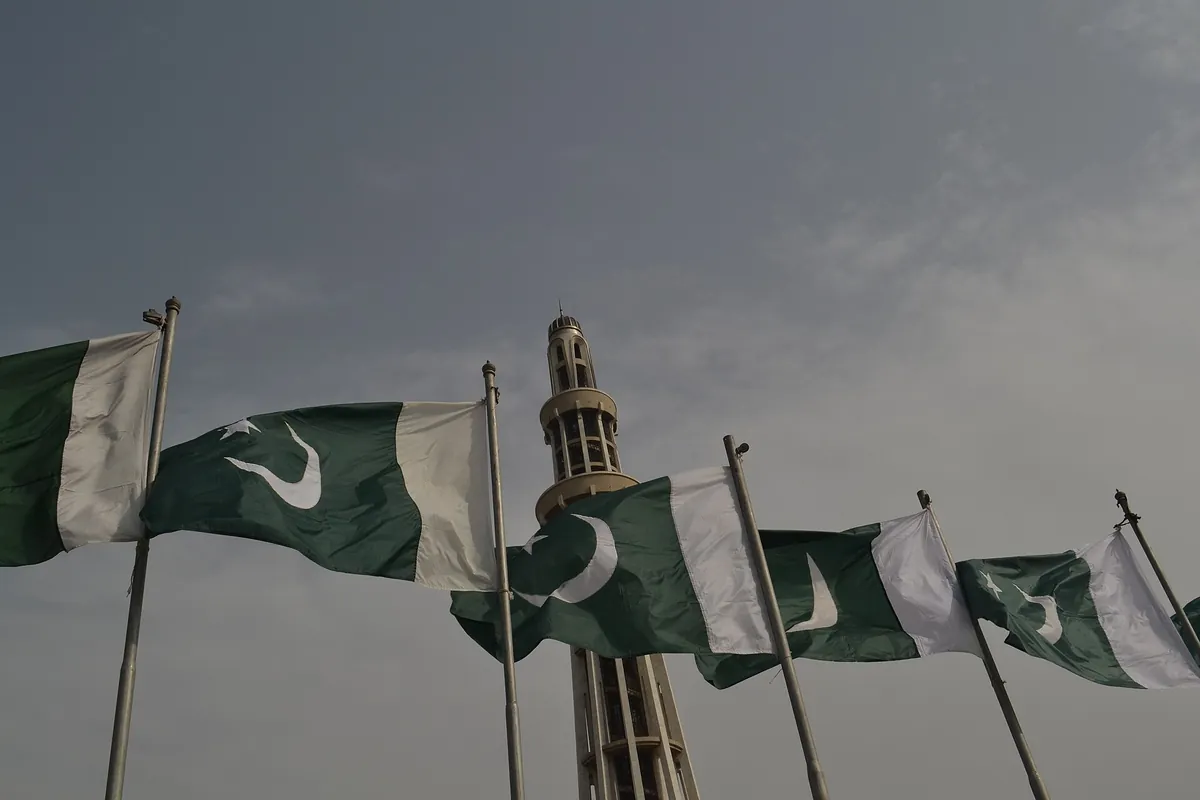
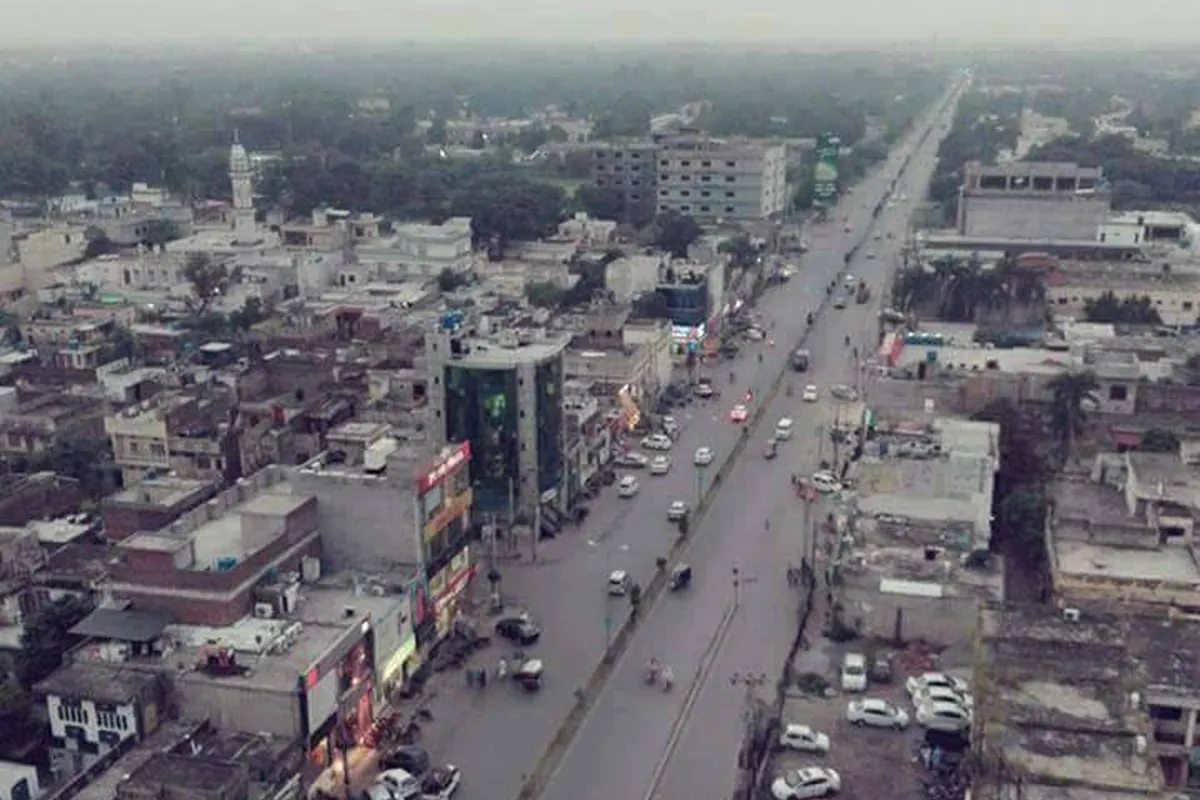
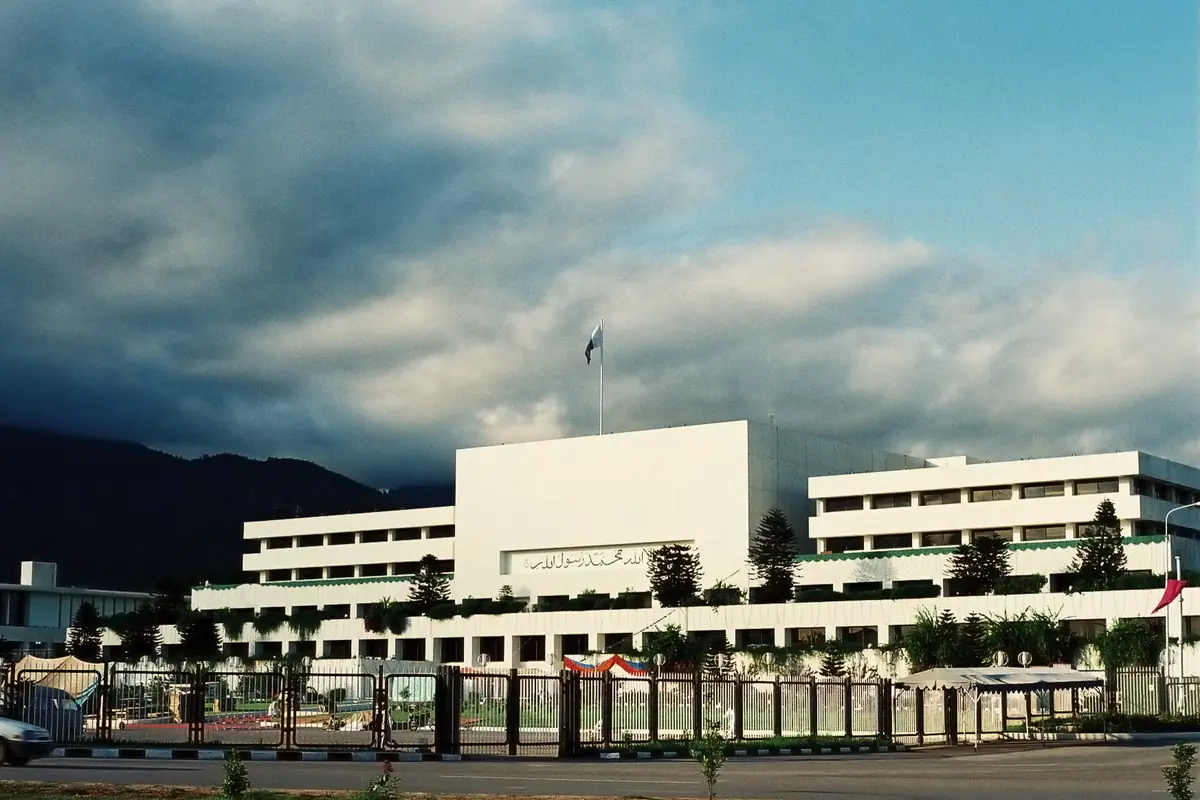
Images in this article are Wikimedia Commons file photographs — the Sialkot Clock Tower (PakGuru99, CC BY-SA 4.0), Pakistani flags at Minar-e-Pakistan, Lahore (Susmanhamza, CC BY-SA 3.0), a Sialkot boulevard (YaminJanjua, CC BY-SA 4.0), and Parliament House, Islamabad (Usman Ghani, CC BY-SA 3.0) — and are not photographs of the minister, the convocation, or the speech.
Sources
This report is based on reporting, official statements and documents from:
- The Express Tribune — Marka-e-Haq victory enhanced Pakistan's prestige: Defence Minister Khawaja Asif (31 Oct 2026; queue d906b22bcaccb92a)
- Asal Media — Khawaja Asif tells Islamic world: foreign bases can't buy security (31 Oct 2026; full report of the UCP Sialkot convocation speech)
- The Diplomatic Insight — Marka-i-Haq victory enhanced Pakistan's global position: ministers (May 2026, first anniversary)
- TaazaPulse — DG ISPR: Pakistan 'cautiously optimistic' on US-Iran mediation (30 Oct 2026; background)
- Photos: real file photographs (Wikimedia Commons) — Sialkot Clock Tower, Pakistani flags at Minar-e-Pakistan Lahore, Sialkot Boulevard, Parliament House Islamabad; file photos, not the minister or the convocation
Frequently Asked Questions
Where and when did Khawaja Asif make this speech?
On Saturday 31 October 2026, at the annual convocation of the University of Central Punjab in Sialkot, as reported by The Express Tribune and in a fuller same-day report of the address. He congratulated the graduating students and told them an educated, skilled youth could play a vital role in the country's development.
What exactly did he say about Marka-e-Haq and Pakistan's prestige?
He said Pakistan had earned a prominent position on the global stage, particularly following its victory in Marka-e-Haq, and that its diplomatic standing had improved significantly. He described it as a matter of pride that Pakistan had achieved an international standing it had not attained during its previous 78 years, and said Pakistan had defeated an adversary five times larger than itself. Those are his characterisations, reported here as his words.
What did he say about foreign military bases?
He warned that foreign military bases offer no guarantee of security and urged nations to depend on their own strength. His reported words were: “Military bases established by foreign powers cannot protect you. Such bases are created to serve vested interests, while real security comes from your own strength.” He added that the largest foreign base in the region had been established to protect the Zionist state.
Did the speech announce any new policy or agreement?
No. Nothing in the reporting of the convocation address records a new defence policy, a change in force posture, a new agreement with any foreign state, or a response to a specific development of the day. It was a convocation address, not a parliamentary statement, a press conference, or a military briefing, and no official statement was issued alongside it in the reporting seen.
What is Marka-e-Haq?
Marka-e-Haq, the Battle for Truth, is the name Pakistan gives to its side of the May 2025 military confrontation with India, which escalated after the attack on tourists in Pahalgam in April 2025 and ended with a ceasefire on 10 May 2025. Pakistan's armed forces responded with an operation named Bunyan-um-Marsoos. The two governments have described the confrontation in sharply different terms, and the naming itself is part of that difference.
Did Asif really claim Donald Trump mentioned India's defeat 11 times?
Asif claimed it in the speech: the fuller report records him saying US President Donald Trump had referred to India's defeat 11 times and had mentioned the downing of Indian aircraft on several occasions. That count is Asif's claim, not a count this newsroom has independently verified from transcripts, and it is reported in this article only with that attribution. Likewise, his assertion that Indian leaders acknowledged defeat is his characterisation, not a quotation from an Indian leader.