How to Apply for a Pakistani Passport: A Step-by-Step Guide

A Pakistani passport is a small green book with an outsized power: it is the difference between watching a brother's wedding in Dubai on a video call and being there. Getting one — or renewing one — is a well-worn path travelled by millions, and it rewards the prepared. The Directorate General of Immigration and Passports (DGIP) now lets you do most of the paperwork online, charges a fee that depends on the choices you make, and asks for exactly one thing that cannot be digitised: you, in person, for ten minutes of biometrics.
This guide lays out the complete journey: the decisions to make before you apply, the documents for adults, minors and renewals, the online application and appointment, what actually happens inside the passport office, and how long each speed of processing really takes.
Decide three things before you apply
Your application — and your fee — is built from three choices. Make them calmly now, not at a counter with a queue behind you.
Pages: 36, 72 or 100. Each entry and exit stamps and every visa eats space. A 36-page booklet suits occasional travellers. If you travel for work, study in one country while visiting family in another, or simply expect a busy five years, the 72-page booklet is the sweet spot; frequent business travellers take 100.
Validity: 5 or 10 years. Adults can choose either. The 10-year passport costs more upfront but less per year, and it postpones the renewal errand by half a decade — for most adults it is the better arithmetic. Children under 15 are issued 5-year passports only, because their faces change faster than the booklet wears out.
Speed: normal, urgent or fast track. Same book, different queue. Normal processing takes roughly three weeks, urgent around ten working days, and fast track a few working days at designated offices. The fee climbs with each step. If a visa appointment or a flight depends on the passport, buy speed; if nothing is booked, normal is money saved for the trip itself.
There is also a newer fourth dimension: the e-passport, which embeds a chip carrying your biometric data to international ICAO standards and works with automated e-gates where airports have them. It costs somewhat more than the traditional machine-readable passport, which remains fully valid and accepted everywhere. Neither choice will ever be the reason a visa is refused — pick on budget and convenience.
Documents you will need
- Adult, new passport: your original valid CNIC. That is the core of it — the passport system is built on NADRA's record, so whatever your CNIC says is what your passport will say.
- Renewal: your original CNIC and your previous passport. The old booklet is cancelled when the new one is issued.
- Minors: the Child Registration Certificate (B-Form), the CNICs of both parents, and the parents' presence or consent as the office requires. For a renewal, the child's previous passport as well.
- Government servants: a No Objection Certificate from your department is required in the standard course.
- Dual nationals and special cases: additional documentation can apply; the online portal flags what your category needs before you pay.
The fee: why nobody can quote you one number
Ask five people what a passport costs and you will get five confident, different answers — because there is no single fee. The amount is calculated from your three choices plus the e-passport question: more pages cost more, ten years costs more than five, and each speed tier multiplies the bill. The schedule is also revised from time to time.
So treat every fixed figure quoted by an agent, a photocopy shop or a well-meaning relative with polite suspicion. The trustworthy number is generated by the DGIP system itself: when you complete the online application, the portal calculates the exact fee for your combination and issues a payment slip (PSID/challan) for that amount. Pay that, through the channels the slip specifies — designated banks and the digital payment options the portal offers — and keep the paid proof. A generated challan that sits unpaid typically expires after about 30 days, after which you simply generate a fresh one at the then-current fee.

Step by step: the application
- Create your account on the DGIP online application portal and verify it.
- Complete the application form exactly as your CNIC reads — every name, every date. The form asks you to choose pages, validity and processing speed.
- Upload documents and photograph where the portal requires them, following its size and format guidance; blurred uploads are a quiet cause of delay.
- Pay the calculated fee through the generated payment slip and keep the proof of payment.
- Book your appointment at your chosen passport office — regional passport offices serve every major city, with executive offices in the largest ones — on a day you can attend in person.
- Attend the office with your original documents and payment proof (details below).
- Receive your token/slip with the tracking reference after biometrics.
- Collect the passport when notified it is ready, or receive it through the delivery option where offered.
Prefer paper? The offices still process walk-in applications on the traditional route — form at the office, fee at the bank, same biometric visit — but the online route front-loads the queueing onto your sofa, which is where queueing belongs.
Inside the passport office: your one visit
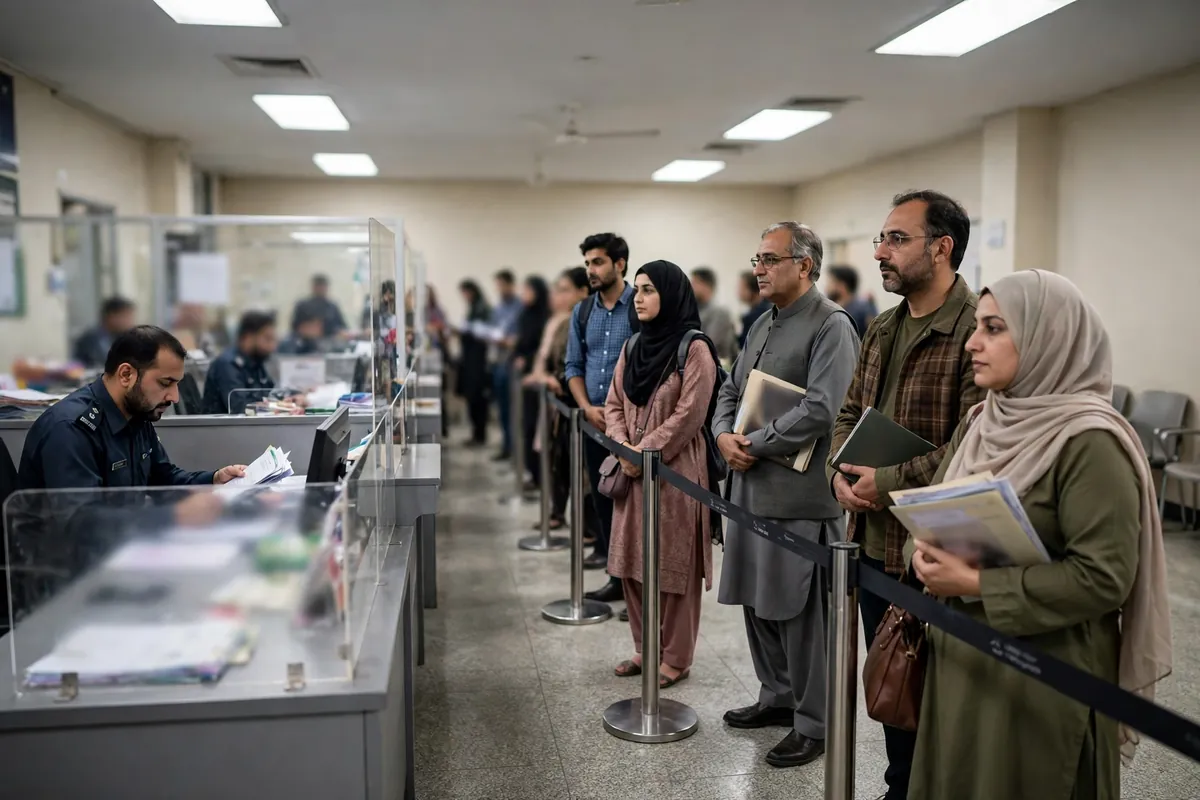
Arrive a little before your appointment with your original CNIC, your previous passport if renewing, and your payment proof. The visit moves through a fixed choreography: your documents are checked against the application, your fingerprints are captured for biometric verification against NADRA's record, and your photograph is taken at the office to the required specification — which is why you do not need to bring studio photographs for the standard process. You will be given a receipt carrying your application reference; that slip is your collection document and your tracking key, so photograph it before you leave the building.
Practical notes from a thousand queues: carry photocopies of everything as backup, keep your phone charged for the SMS updates, and expect the visit to take anywhere from twenty minutes in an executive office to a couple of hours in a busy regional one. Nobody legitimate inside or outside the office can take money to move your file faster than the tier you paid for — the queue is the tier.

After you apply: tracking and collection
Processing starts after a successful biometric visit. DGIP sends SMS updates as your passport moves through printing and dispatch, and the portal lets you follow the application with your reference. Judge progress against the tier you bought: roughly three weeks for normal, around ten working days for urgent, a few working days for fast track — counted from the biometric visit, and stretching a little in peak seasons such as the run-up to Hajj and the summer holidays.
When you collect, check the book before you leave: name, date of birth, passport number, photograph, and the machine-readable zone at the bottom of the data page. An error reported at the counter is a printing correction; the same error discovered at an airport is a cancelled trip. Store the passport flat, dry and away from the magnetic clasps of handbags and phone covers that can damage the chip in e-passports.
Renew early: the six-month rule
The most expensive passport mistake in Pakistan is not losing the booklet — it is letting its validity quietly shrink below six months. A long list of countries refuses entry unless your passport remains valid for at least six months beyond your return date, and airlines enforce the rule at check-in because they carry the fine for flying you there. Renewal is simply this same process run again: form, fee, appointment, biometrics, old book surrendered and cancelled. Build the habit — when validity drops under a year and travel is even a possibility, start the renewal. Your future self, boarding pass in hand, sends thanks.
Frequently Asked Questions
What documents are required for a Pakistani passport?
An adult applicant needs an original, valid CNIC. For a renewal, bring the previous passport as well. Minors apply with their B-Form or Child Registration Certificate and the CNICs of both parents, and government servants may need a departmental NOC. If your CNIC details and your documents disagree, fix the CNIC record first — a mismatch is the most common cause of delay.
Can I apply for a passport online in Pakistan?
Yes. The Directorate General of Immigration and Passports (DGIP) runs an online application portal where you create an account, complete the application form, upload your documents and photograph, pay the fee and book an appointment. The online steps do not remove the office visit: you still attend once, in person, for fingerprint biometrics and final verification.
How much does a Pakistani passport cost?
There is no single fee: the amount depends on the booklet size (36, 72 or 100 pages), the validity you choose (5 or 10 years), the processing speed (normal, urgent or fast track) and whether you choose the chip-embedded e-passport. Because the schedule is revised periodically, the reliable figure is the one the DGIP portal calculates for your exact choices when it generates your payment slip — check it there before paying rather than trusting any agent's quote.
How long does it take to get a passport?
Processing time follows the tier you pay for: normal is the slowest at roughly three weeks, urgent is around ten working days, and fast track is a few working days at designated offices. These are processing estimates after your successful biometric visit, so apply well before any travel date and never book non-refundable tickets against an unissued passport.
What is the difference between a normal passport and an e-passport?
The e-passport carries an embedded chip holding your biometric data to international ICAO standards, which speeds up automated border checks where they exist. The traditional machine-readable passport remains valid and accepted worldwide. The e-passport costs somewhat more; the application process is otherwise the same.
Can I renew my passport before it expires?
Yes, and you should. Many countries refuse entry unless your passport stays valid for at least six months beyond your trip, and airlines enforce the rule at check-in. Renewal follows the same route as a new application — form, fee, appointment, biometrics — with your old passport surrendered and cancelled when the new one is issued.