Pakistan Assumes G-24 Chairmanship as PM Shehbaz Welcomes a Diplomatic Milestone
Pakistan has assumed the chairmanship of the Intergovernmental Group of Twenty-Four (G-24), the developing-country bloc that coordinates its members' positions on monetary and development finance at the International Monetary Fund and the World Bank. Prime Minister Shehbaz Sharif welcomed the development on Sunday 1 November 2026, calling it a significant diplomatic milestone for the country, and congratulated Finance Minister Muhammad Aurangzeb on assuming the chairmanship. The state broadcaster Radio Pakistan reported the takeover on Sunday, and the Prime Minister's Office statement was carried by Pakistan TV the same day. Pakistan, represented by Finance Minister Aurangzeb, takes over as chair of the group from Nigeria.
In the statement from the Prime Minister's Office, the Prime Minister said the position recognises Pakistan's role in the global economy. He credited Finance Minister Muhammad Aurangzeb and the Ministry of Finance for their diplomacy and professional competence, and said efforts made during the annual meetings of the International Monetary Fund and the World Bank had secured a prominent position for Pakistan among developing nations. Pakistan intends to use the platform to advocate for reforms in the global financial system and to seek fair financial aid to combat climate change, according to the statement. Pakistan's leadership agenda, as described by the Press Information Department, focuses on development-led growth, stronger global representation for developing economies, and long-overdue reforms in the international financial architecture.
Finance Minister Aurangzeb has reaffirmed Pakistan's commitment to strengthening the collective voice of developing economies and promoting a more responsive and fair international financial system. He outlined three strategic priorities for Pakistan's chairmanship: development-led growth, stronger representation for developing economies, and reform of the international financial architecture. He stressed that Pakistan's chairmanship would be guided by the G-24's principles of consultation, consensus and collective advocacy, working closely with members from Africa, Asia, Latin America and the Caribbean, as well as international partners like the IMF and the World Bank. He also set his own test for the year: the effectiveness of collective leadership must be judged by tangible development outcomes, not by statements alone.
The 1 November announcement did not come out of nowhere, and readers should understand exactly what changed on Sunday and what was already settled weeks earlier. On 14 October 2026, Aurangzeb, speaking in his capacity as First Vice-Chair of the G-24 at the Finance Ministers and Central Bank Governors' Meeting held on the sidelines of the World Bank Group-IMF Annual Meetings 2026 in Bangkok, Thailand, reaffirmed Pakistan's commitment as incoming chair of the group and outlined the same three priorities. That meeting, reported by the Associated Press of Pakistan and the Press Information Department on 13-14 October, is where Pakistan's succession to the chair from Nigeria was publicly established. WE News reported at the time that Pakistan was expected to assume the chairmanship at the conclusion of the World Bank-IMF Annual Meetings in October 2026, succeeding Nigeria, and that the G-24's governance rules provide for the chair-country's one-year term to begin at the end of the Annual Meeting of Ministers. What happened on 1 November, then, is the formal assumption of a chairmanship whose succession was settled in Bangkok, together with the Prime Minister's public welcome of it — not a fresh election held on Sunday. No vote tally for any chairmanship vote appears in the reporting seen for this article, and this article invents none: where The Nation's headline describes Pakistan's "election" as chairman, the underlying reporting describes a takeover and assumption in succession to Nigeria, and this article uses that language.
So what is the G-24, and why does chairing it matter? The Intergovernmental Group of Twenty-Four was established in 1971 to coordinate developing nations' positions on monetary and development finance at the IMF and the World Bank, and its mandate expanded in 1976 to encompass broader development issues. The group operates at both political and technical levels and reaches decisions by consensus ahead of the IMF and World Bank's biannual meetings, releasing a Ministerial Communiqué that sets out its collective positions. A bureau, representing three regional groups and past chairs, leads the organisation, and the group meets twice a year, just before the IMF and World Bank's Spring and Fall Meetings. Its members are represented by their finance ministries and central banks, which is why the chair is held at finance-minister level rather than by a head of government: Pakistan is the chair country, and Finance Minister Aurangzeb is the minister who exercises the chair.
Pakistan TV's 1 November listing names the group's membership as follows. The African members are Algeria, Congo, Côte d'Ivoire, Egypt, Ethiopia, Gabon, Ghana, Kenya, Morocco, Nigeria and South Africa. The Asian members are Iran, Lebanon, Pakistan, the Philippines, India and Sri Lanka, with China as a special invitee. The Latin American and Caribbean members, as listed by the same source, are Argentina, Brazil, Colombia, Ecuador, Guatemala, Haiti, Mexico, Peru, Syria, Trinidad and Tobago and Venezuela. That is a wide coalition — African, Asian and Latin American and Caribbean economies with very different sizes, export profiles and debt positions — and it is precisely that breadth that makes the chair's consensus-building job difficult and, when it works, valuable: a joint G-24 position carries the weight of the developing world speaking together rather than of any single capital speaking alone.
The chair's practical job is agenda-setting. As an explainer of the 14 October Bangkok reporting put it, the chairmanship gives Pakistan a year-long setting of the agenda for the group's annual work: the chair is typically the lead minister who speaks on behalf of the G-24 in the plenary settings of the IMF's International Monetary and Financial Committee and the World Bank's Development Committee, and who shapes the group's communiqués ahead of the spring and annual meetings. That is influence of a particular kind. It does not change any country's vote share at the IMF or the World Bank, it does not by itself unlock new financing for Pakistan, and it does not settle any loan review. What it does is give Pakistan the pen, for a year, on the document in which developing countries state their common case — on development finance, on representation inside the Bretton Woods institutions, and on the architecture of the system itself — and the microphone when that case is presented to the institutions' governing bodies.
The case Pakistan says it will make is spelled out in Aurangzeb's own remarks, in Bangkok and again on 1 November. In Bangkok he highlighted the challenges facing developing economies: fragmentation disrupting trade and investment, climate shocks eroding development gains, restrictive financial conditions and widening financing gaps. He stressed that reform of the international financial architecture must keep pace with those challenges. On 1 November he emphasised the need for renewed international cooperation, stronger multilateral institutions and reinforced global commitments to address climate shocks, development financing gaps and global economic fragmentation. The three priorities — restoring development as the central objective of the international financial system, making the Bretton Woods institutions more representative and responsive, and building a development-oriented international financial architecture — are the same in both statements, which is itself a signal: this is a prepared programme for the chair year, not a slogan improvised for a Sunday headline.
For Pakistan, the chairmanship also lands in a particular domestic context that readers will recognise, though the 1 November reporting announces no new financing and no change to any existing programme. Pakistan's economy is discussed in the same breath as its external financing needs in much of the year's economic reporting, and the chair gives Islamabad a platform to argue the developing-country case from inside the room rather than from outside it. The climate-finance element of the Prime Minister's statement deserves emphasis on its own: Pakistan has repeatedly argued, in international forums, that countries hit hardest by climate shocks should get fairer access to finance for coping with them, and the Prime Minister's statement explicitly ties the G-24 platform to seeking fair financial aid to combat climate change. Whether that advocacy produces anything concrete will be measured, as Aurangzeb himself said, by tangible development outcomes — not by the fact of the chairmanship alone.

What should readers watch next? First, the G-24's next ministerial communiqué, ahead of the Spring Meetings, which will show whether Pakistan's three priorities survive contact with 24-plus capitals and appear as joint positions rather than as Pakistan's own talking points. Second, whether the group's statements begin to carry specific proposals — on representation, on development finance, on climate finance — rather than general calls for reform. Third, how Pakistan uses the chair's microphone in the IMF and World Bank plenary settings, where the chair speaks for the group. And fourth, the judgement Aurangzeb invited on 1 November: at the end of the chair year, when the chair passes to the next country, will developing economies be able to point to anything that changed because Pakistan held the pen? That is the honest test, and it is a year away.
It is worth spelling out what "stronger representation" means in this programme, because it is the least concrete-sounding of the three priorities and the one most often reduced to a slogan. In the G-24's own terms, as reflected in Aurangzeb's Bangkok remarks, the argument is that the Bretton Woods institutions — the IMF and the World Bank, created at Bretton Woods in the 1940s — should become more representative of and responsive to the countries that now make up most of their membership and bear the brunt of the shocks those institutions are called on to manage. Developing countries have argued for decades that their voice inside those institutions does not match their numbers or their needs, and the G-24 exists precisely to turn that diffuse complaint into a single negotiated position before the institutions' governing meetings. A chair who can hold a consensus position across African, Asian and Latin American and Caribbean members therefore matters more than any single speech: the communiqué is the instrument, and consensus is what gives it weight. That is also why the group's working method — political and technical tracks, decisions by consensus, a bureau drawn from the three regional groups and past chairs — is not bureaucratic decoration. It is how a coalition this diverse avoids splitting into regional blocs and arriving at the IMF and World Bank with three different positions instead of one.
The road to the chair also explains why the handover was orderly rather than contested in public. Aurangzeb chaired the 14 October ministerial meeting in Bangkok as First Vice-Chair, the position from which the incoming chair traditionally steps up, and the annual meetings themselves ran from 12 to 18 October at the Queen Sirikit National Convention Center in Bangkok, according to the IMF's published programme for the meetings. The sequence — vice-chair chairs the ministerial meeting, the annual meetings conclude, the incoming chair's one-year term begins — is the governance rhythm WE News described when it reported that Pakistan was expected to assume the chairmanship at the conclusion of the October meetings. Sunday's announcement is the public confirmation of that sequence, with the Prime Minister's welcome giving it political weight at home. None of this diminishes the development: a year in the chair of the developing world's main coordination group inside the IMF-World Bank system is a real platform. It simply places the news on its correct date — a succession completed and welcomed on 1 November, prepared in Bangkok in mid-October — rather than presenting it as a surprise election.
There are also things this story is not, and honest reporting should say so plainly. It is not a United Nations appointment, and the G-24 is not a UN body: it is a developing-country coordination group that works with the IMF and the World Bank. It is not a bilateral deal with any single country, and no new loan, grant or investment was announced in the 1 November reporting. It is not a prize awarded on Sunday by a vote whose result can be quoted, because no such vote tally appears in the reporting seen. And it does not, on its own, change Pakistan's economic fundamentals: the chairmanship is a platform and a microphone, and its value will be decided by what Pakistan does with them over the coming year.
Sources and honesty note: the 1 November assumption and the Prime Minister's welcome are reported by Pakistan TV (Prime Minister's Office statement, 1 November 2026), Radio Pakistan via Daily Imroz (1 November 2026), and Daily The Destination (1 November 2026); the Bangkok succession and the three priorities are reported by the Associated Press of Pakistan and the Press Information Department (13-14 October 2026) and WE News. The Nation's headline reached TaazaPulse through the sentinel queue; its body was not directly fetched for this article, and no quotation in this article is attributed to The Nation's body. No vote tally, term end date beyond the one-year convention reported by WE News, new financing package, or IMF/World Bank decision is claimed, because none appears in the reporting seen. The photographs are reused TaazaPulse file photos, captioned as such, and none is presented as a photograph of a G-24 meeting or of any named person.
Sources
This report is based on reporting, official statements and documents from:
- The Nation via Google News — PM Shehbaz welcomes Pakistan's election as G-24 chairman, calls it diplomatic milestone (1 Nov 2026; sentinel queue 67ff5f9ae83a7f65; headline only, body not directly fetchable this run)
- Pakistan TV — Pakistan assumes chairmanship of G-24 global economic group (1 Nov 2026, Prime Minister's Office statement + Press Information Department agenda; G-24 background and member list)
- Daily Imroz — Pakistan Takes Over G-24 Chairmanship (1 Nov 2026, citing state broadcaster Radio Pakistan; Aurangzeb priorities and chairmanship principles)
- Daily The Destination — Pakistan Assumes G-24 Chairmanship As Aurangzeb Outlines Three Strategic Priorities (1 Nov 2026)
- APP / Press Information Department via Tez Khabar — Finance Minister calls for reform of international financial architecture at G-24 meeting, reaffirms Pak's commitment as incoming chair (Bangkok, 13-14 Oct 2026)
- WE News English — Pakistan Set To Lead G-24 Call For Global Reform (Oct 2026; expected assumption at conclusion of Annual Meetings, succeeding Nigeria; one-year term from end of Annual Meeting of Ministers)
- KhabarWire explainer of Express Tribune Bangkok reporting — Pakistan takes G-24 chair in Bangkok (14 Oct 2026; annual meetings 12-18 Oct, Queen Sirikit National Convention Center; chair's agenda-setting and plenary role)
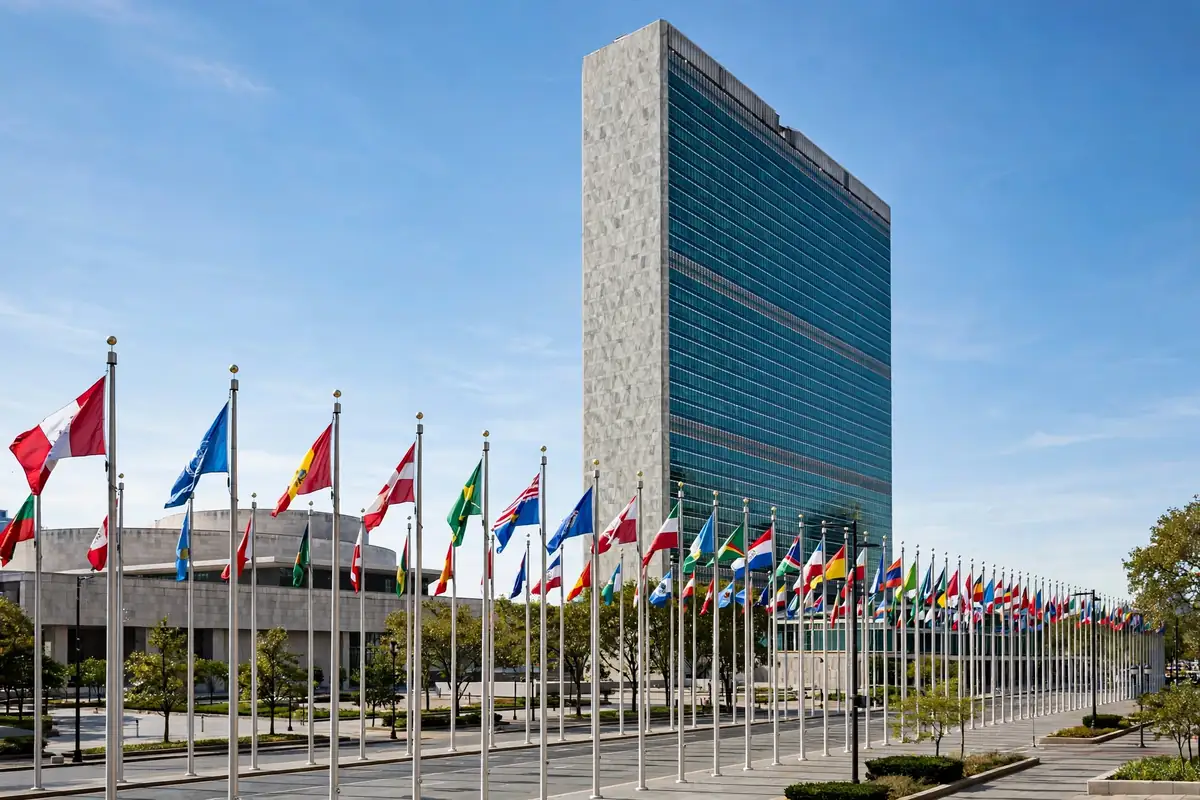
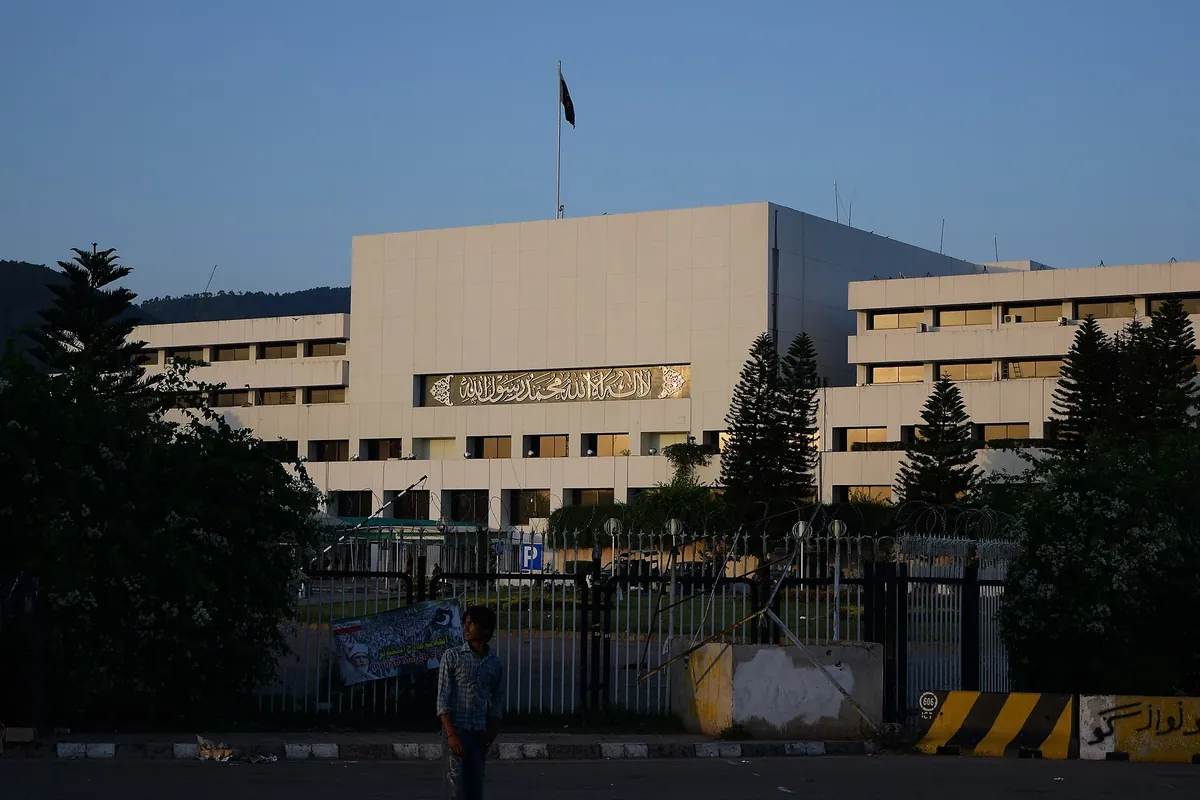
- Photos: reused TaazaPulse file photos, visually inspected this run — UN headquarters flags (featured), Parliament House Islamabad, conference table, central bank building; none is a G-24 meeting photo or a photograph of any named person
Frequently Asked Questions
What is the G-24?
The Intergovernmental Group of Twenty-Four on International Monetary Affairs and Development, established in 1971 to coordinate developing nations' positions on monetary and development finance at the International Monetary Fund and the World Bank. Its mandate expanded in 1976 to broader development issues. It operates at political and technical levels, decides by consensus ahead of the IMF and World Bank's biannual meetings, and publishes a Ministerial Communiqué setting out its collective positions. Its members are represented by their finance ministries and central banks, and it meets twice a year, just before the IMF and World Bank's Spring and Fall Meetings.
Was Pakistan 'elected' G-24 chairman on 1 November 2026?
The reporting describes an assumption, not a fresh election held on 1 November. Pakistan's succession to the chair from Nigeria was established on 14 October 2026 in Bangkok, when Finance Minister Muhammad Aurangzeb, speaking as the G-24's First Vice-Chair, reaffirmed Pakistan's commitment as incoming chair. The G-24's governance rules provide for the chair-country's one-year term to begin at the end of the Annual Meeting of Ministers, and WE News reported Pakistan was expected to assume the chair at the conclusion of the October Annual Meetings. What happened on 1 November is the formal assumption plus Prime Minister Shehbaz Sharif's public welcome of it. No vote tally appears in the reporting seen, so this article claims none.
What are Pakistan's three priorities as G-24 chair?
Finance Minister Muhammad Aurangzeb has set out the same three priorities in Bangkok on 14 October and again on 1 November: development-led growth; stronger representation for developing economies; and reform of the international financial architecture. In fuller form, from the Bangkok statement, that means restoring development as the central objective of the international financial system, making the Bretton Woods institutions more representative and responsive, and building a development-oriented international financial architecture. Aurangzeb says the chairmanship will be guided by consultation, consensus and collective advocacy, and judged by tangible development outcomes.
Who actually exercises the chair — the Prime Minister or the Finance Minister?
Pakistan is the chair country, and the chair is exercised at finance-minister level: Pakistan, represented by Finance Minister Muhammad Aurangzeb, takes over from Nigeria. Prime Minister Shehbaz Sharif welcomed the development and congratulated Aurangzeb on assuming the chairmanship, crediting him and the Ministry of Finance for their diplomacy and professional competence. That division of roles is normal for the G-24, whose members are represented by their finance ministries and central banks.
How long does Pakistan's G-24 chairmanship last?
One year, on the convention reported by WE News from the G-24's governance rules: the chair-country's term begins at the end of the Annual Meeting of Ministers. Pakistan's term therefore runs from the conclusion of the October 2026 Annual Meetings, with the next ministerial communiqué — ahead of the Spring Meetings — the first real test of whether its three priorities appear as joint G-24 positions.
Does chairing the G-24 give Pakistan new powers at the IMF or World Bank?
No. The chairmanship does not change any country's vote share, unlock financing on its own, or settle any loan review, and no new financing package was announced in the 1 November reporting. What it gives Pakistan for a year is the agenda-setting pen and the microphone: the chair is typically the lead minister who speaks for the G-24 in the IMF's International Monetary and Financial Committee and the World Bank's Development Committee plenary settings, and who shapes the group's communiqués. Its value will be decided by what Pakistan does with that platform over the chair year.