Pakistan Halal Forum Eyes $50 Billion Export Opportunity From Karachi
Pakistan's first dedicated halal-economy platform closed in Karachi on Saturday 31 October 2026 with an ambition stated in its largest round number: turning the country's tiny share of the global halal market into a $40-50 billion export opportunity. The 1st Pakistan Halal Forum 2026, held at the Pearl Continental Hotel in Karachi under the theme "The Intelligent Halal Economy", brought national and international stakeholders together for a day of keynotes, panel discussions, business-to-business networking, and certification sessions — and ended with a commitment to make the forum an annual platform, with dedicated Halal Economic Zones, support programmes for small and medium enterprises, and investment facilitation for halal industries. Arab News carried the ambition in its headline form, as Pakistan eyeing a bigger share of the global halal market with a $50 billion export ambition; the forum's own account, reported the same day, puts the figure as a $40-50 billion opportunity, and this article uses that range, because the upper end alone, without the range and without a date, would make a long-term aspiration sound like a target with a deadline. There is no deadline in the reporting. There is an argument, a set of proposals, and a first platform on which they were made — and those are reported here for exactly what they are.
The forum was organised by the Halal Development Council, co-organised by the Pakistan Halal Authority and International Halal Certification, with DinarStandard as knowledge partner and the endorsement of the World Halal Council. That line-up is itself part of the story. Pakistan's halal trade has long suffered, on the industry's own account, from fragmentation: multiple certifiers, uneven standards, and exporters left to prove compliance market by market. A forum that puts the national authority, a private council, an international certifier, a global market-intelligence firm, and a world council on the same stage is an attempt to present a single front — and the forum's central proposal follows from it. Organisers said Pakistan should move from raw-material exports to value-added, certified products, support small and medium enterprises, and establish "One National Halal Mark, One Standard". The slogan is doing real work in the proposal: a single national mark would let a buyer in the Gulf or South-East Asia recognise a Pakistani product's halal status without re-checking which of several domestic certifiers stood behind it, and a single standard would give small exporters one set of rules to meet instead of several.
The paradox the forum started from
The forum's starting point, as organisers stated it on the day, is a paradox. Pakistan is the world's second-largest Muslim population, yet it holds less than 1% of the global halal economy. The global industry itself is put at around $3 trillion in the forum's account — a figure that covers far more than food, and the breadth of that coverage was visible in the forum's programme. Sessions and growth strategies covered halal food, pharmaceuticals, cosmetics, modest fashion, halal tourism, logistics, Islamic finance, and technology-driven traceability. That breadth matters for understanding the $40-50 billion figure: it is not a meat-export figure alone, even though meat is where Pakistan's current halal exports are concentrated and where the most concrete numbers exist. It is an economy-wide opportunity figure, spanning products and services in which halal certification is a mark of quality, hygiene, and safety for Muslim and non-Muslim buyers alike — a point stressed at the forum by Mufti Zeeshan Abdulaziz, chief executive of International Halal Certification, who said halal is now a global benchmark for quality, hygiene, and safety, driven by technologies such as QR-code traceability, blockchain verification, and AI-based audit, and that his organisation's globally accepted certification will help Pakistani products gain international market access.
The chairman of the Halal Development Council, Asad Sajjad, framed the forum as a beginning rather than a showcase. "This forum is not just an event, it is the beginning of positioning Pakistan as a Global Halal Hub," he said, adding that the focus is on public-private partnership, innovation, and export facilitation to connect Pakistani businesses with buyers in the Gulf Cooperation Council states, Malaysia, Indonesia, and beyond. Representatives from DinarStandard, the knowledge partner, shared global insights on the halal lifestyle economy and noted that the world is increasingly looking to Pakistan for authentic halal sourcing. The audience, as reported, matched that ambition: industry leaders, exporters, regulators, scholars, small and medium enterprises, and international delegates. A first forum can be judged, at this stage, only on whether it assembled the right room and left it with a workable agenda. On the reporting of the day, it assembled regulators, certifiers, exporters, and buyers' markets in one hotel in Karachi, and it left with three concrete proposals — one mark, one standard, and dedicated economic zones — rather than only with speeches.
What "One National Halal Mark, One Standard" would change
To see why a single mark matters, consider the journey of a Pakistani food exporter today as industry reporting describes it. The product must satisfy the importing country's halal requirements, which may differ from the requirements of the next market; the certifier's recognition may not travel with the product; and the paperwork proving the supply chain — from farm or factory to port — may be assembled by hand, market by market. The forum's technology theme, "The Intelligent Halal Economy", is aimed at exactly that friction. QR-code traceability would let a buyer or regulator scan a product and see its certification chain; blockchain verification would make that chain harder to alter after the fact; AI-based audit would let certifiers check compliance at a scale that manual inspection cannot reach. None of these technologies was reported as launched at the forum, and this article does not claim otherwise. They were presented as the direction of travel — the "intelligent" in the forum's theme — and the test will be whether any Pakistani exporter can, in the next year, show a product whose halal journey from production to a Gulf supermarket shelf is visible in a single scan.
The shift from raw to value-added is the other half of the proposal, and it is where the $40-50 billion figure either becomes plausible or does not. Pakistan today exports raw and semi-processed agricultural and livestock products in large volumes and captures a small share of the final product's value. A certified, branded, packaged halal product — processed meat, a pharmaceutical, a cosmetic, a ready meal — keeps more of that value at home, supports more jobs in processing and packaging, and is less exposed to commodity price swings than a raw shipment. The forum's emphasis on small and medium enterprises follows from the same logic: Pakistan's halal economy is not only a story of a few large exporters, but of thousands of small firms that cannot individually afford international certification, cold-chain investment, or a presence at a Gulf trade fair. SME support programmes and dedicated Halal Economic Zones, both promised as follow-ups to the forum, are the mechanisms by which a small firm might be brought into that value chain. Whether those mechanisms appear, with budgets and locations, is the first thing to watch after the forum closes.
Where Pakistan stands today: the meat numbers
The most concrete context for the forum's ambition comes from the meat trade, where Pakistan's halal exports are already measured. Meat and meat-product exports reached an all-time high of $512 million in fiscal year 2024, a 20% increase from $426 million in the previous year, according to Pakistan Bureau of Statistics figures reported in industry coverage. The United Arab Emirates remained the largest market, representing 39% of total meat exports valued at about $200 million, with Saudi Arabia second at 28%. Those figures show both the opportunity and the scale of the gap: $512 million is a record for meat, and it is roughly one-hundredth of the $40-50 billion economy-wide opportunity the forum is talking about. The gap is not an error in the forum's arithmetic; it is the point. The forum's figure spans all halal sectors and assumes a transformation — value-added products, new markets, certified services — that has not yet happened. Readers should therefore treat $50 billion not as a forecast with a date, but as a statement of scale: this is how large the prize would be if the transformation succeeded, not how large Pakistan's halal exports are today.
The livestock base behind that ambition is, by the official numbers, very large. Pakistan has 251.3 million livestock, growing at 3.18% a year since 2006, according to the Pakistan Bureau of Statistics' 7th Agricultural Census released in August 2024. The livestock sector accounts for 63.6% of agricultural GDP and 14.97% of total GDP, according to the Economic Survey 2024-25, and the Ministry of National Food Security and Research reported in June this year that more than eight million rural families rely on livestock as their main livelihood. More than 97% of Pakistan's approximately 2.2 million tons of meat production is consumed domestically, according to the Trade Development Authority of Pakistan's Meat Export Strategy 2023-2027 — which means the export story is, for now, a story about a small surplus from a very large domestic system, not about an export machine waiting to be switched on. The forum's challenge is to turn part of that domestic system, without endangering domestic supply, into certified export production. That is a harder task than the headline figure suggests, and it is one the forum's own proposals — zones, SME programmes, investment facilitation — are designed to address, rather than to wish away.
What stands in the way
Industry reporting over the past year gives a consistent list of obstacles, and the forum's agenda reads, in places, as a direct answer to them. Foot-and-mouth disease, weak animal traceability, and uneven slaughterhouse certification have limited access to Gulf markets, and the federal government has ordered an action plan to eradicate the disease and certify abattoirs. Pakistan's meat-processing industry often struggles to meet stringent international standards for hygiene, packaging, and traceability, according to former livestock officials quoted in industry coverage. Infrastructure deficits remain the primary obstacle in the same reporting: in September 2025 the government announced plans to establish modern abattoirs and processing facilities nationwide to meet international halal standards, and the strategy documents speak of investment in cold-storage networks and disease-control systems. Production costs are also part of the story: at a meeting with the Prime Minister's Special Assistant Haroon Akhtar Khan with industry stakeholders on 20 October 2025, production costs were put at $5 per kilogram compared with India's $3.5 per kilogram. None of these obstacles was removed by a one-day forum in Karachi, and this article does not suggest otherwise. What the forum did was gather the institutions that would have to remove them — the authority, the certifiers, the exporters, and the buyers' markets — and give them a shared set of proposals to be judged against.
There are also parallel government efforts that the forum's ambition sits alongside, and they should not be confused with the forum itself. Separately reported discussions with Malaysia, described by the Federal Minister for National Food Security and Research, Rana Tanveer Hussain, at a high-level forum on export strategies, are progressing towards an agreement under which Pakistan's halal meat exports to Malaysia could reach $200 million within five years. That is a bilateral negotiation with a named market and a named figure, and it is different in kind from the forum's economy-wide $40-50 billion opportunity. Similarly, Punjab's separate discussions with Saudi Arabia about food exports, and the August agreement to lift Pakistani agricultural and food exports to the kingdom to $3 billion within two years, are provincial and bilateral tracks. The Karachi forum does not replace those tracks; it provides a national platform on which they could, in principle, be coordinated under one mark and one standard. Whether that coordination happens will be visible in the next round of bilateral announcements, if they start citing the national mark rather than separate arrangements.
What to watch next
Four things will show, over the coming months, whether the 1st Pakistan Halal Forum was a beginning or only an event. First, the annual commitment: the forum concluded with a commitment to make it an annual platform, and the test of that commitment is a date and a venue for the second forum, not a repetition of the promise. Second, the zones: dedicated Halal Economic Zones were promised, and the test is a location, an incentive package, and a first tenant, not a concept note. Third, the mark: "One National Halal Mark, One Standard" is, at present, a proposal by the forum's organisers, and the test is whether the Pakistan Halal Authority adopts it as the national mark and whether a major importing authority recognises it. Fourth, the small firms: SME support programmes were promised, and the test is whether a small exporter that could not previously afford certification can, a year from now, show a certified product on a foreign shelf and say the programme helped it get there. None of these tests has a date in the forum reporting, and this article does not invent one for any of them.
For ordinary readers, the forum's significance is less in the $50 billion headline than in what it signals about where Pakistan's export debate is moving. The country's most familiar export stories — textiles, rice, a single commodity's price — are stories about selling what Pakistan already produces. The halal-economy argument is different: it is about selling trust. A halal mark, credibly certified and traceably documented, is a promise to a buyer who cannot inspect a farm in Punjab from a supermarket in Kuala Lumpur or Riyadh. If Pakistan can make that promise believable at scale, the buyers are there — the Gulf, Malaysia, Indonesia, and beyond, as the forum's chairman listed them — and the livestock, the farms, and the small firms are there too. If it cannot, the $40-50 billion will remain what it is today: a round number from a first forum in Karachi, and a measure of how far the country's halal trade still has to travel from less than 1% to a share that matches its size.
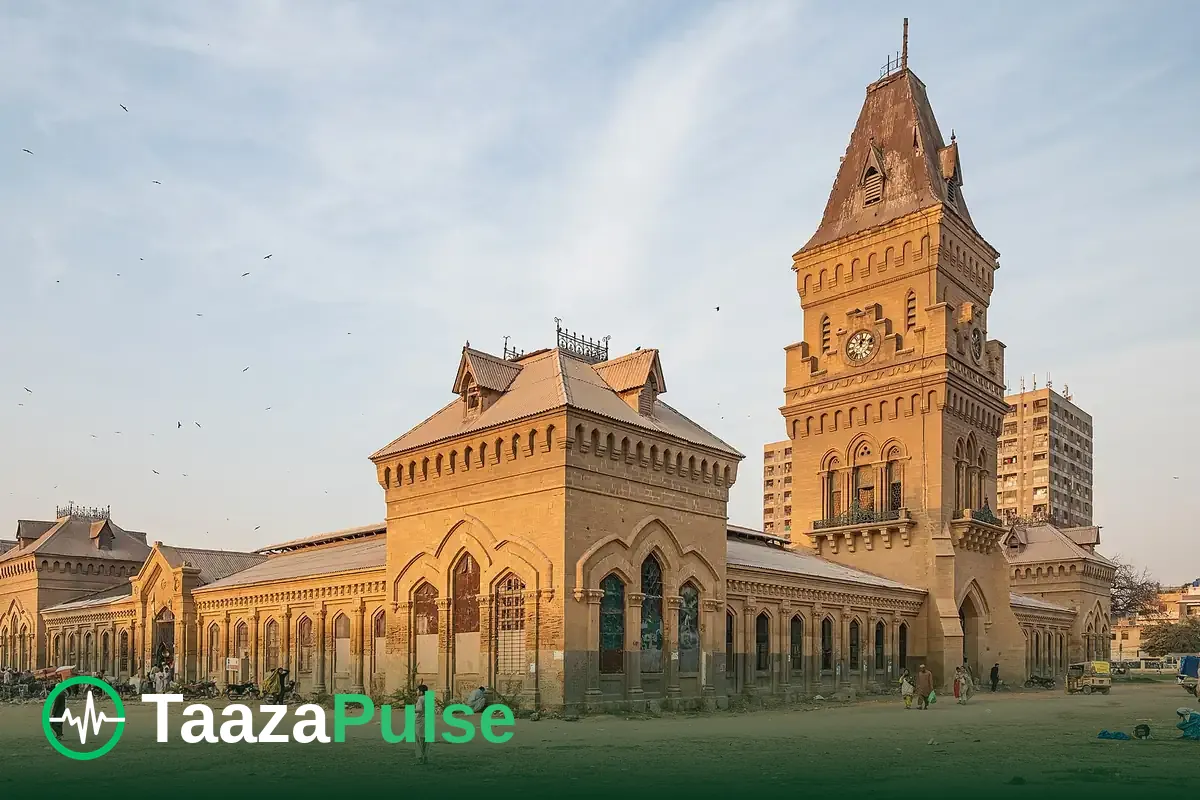
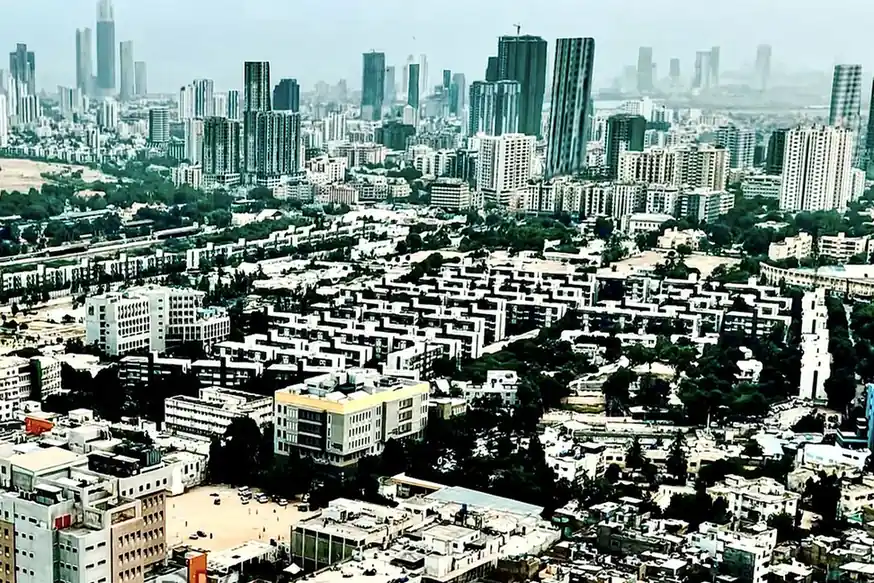
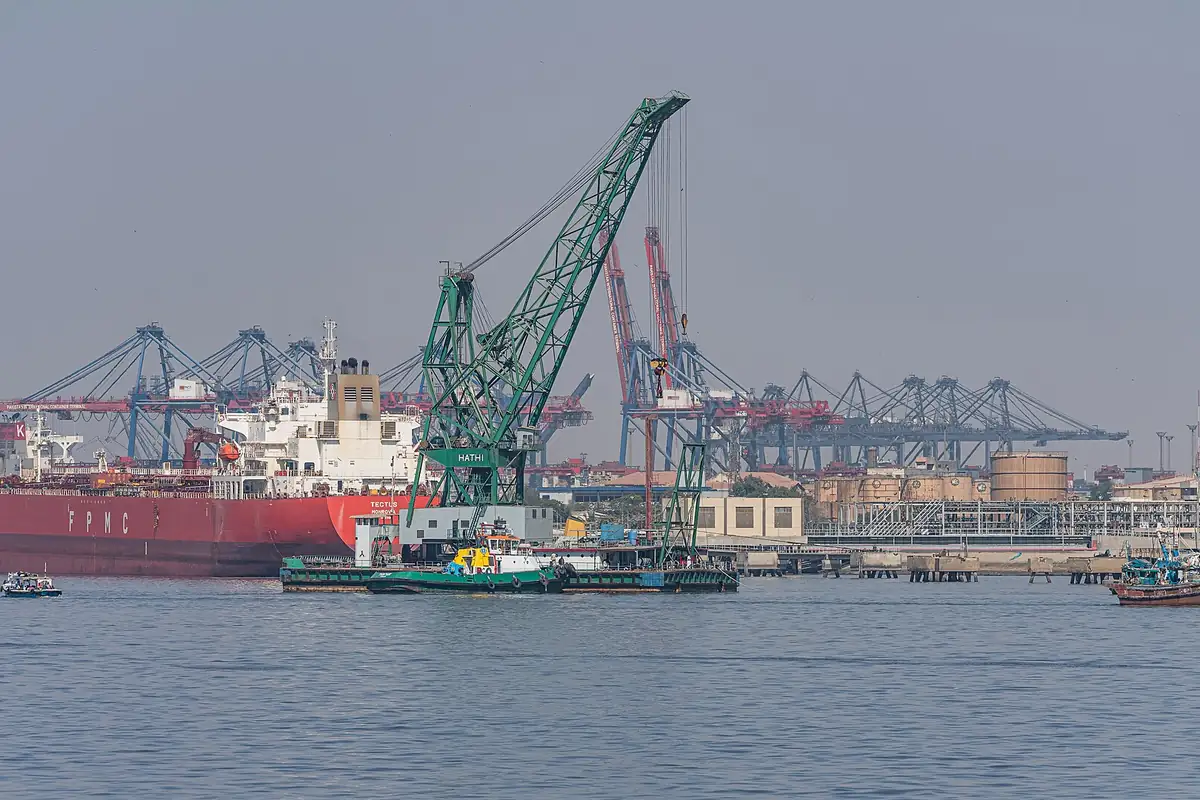
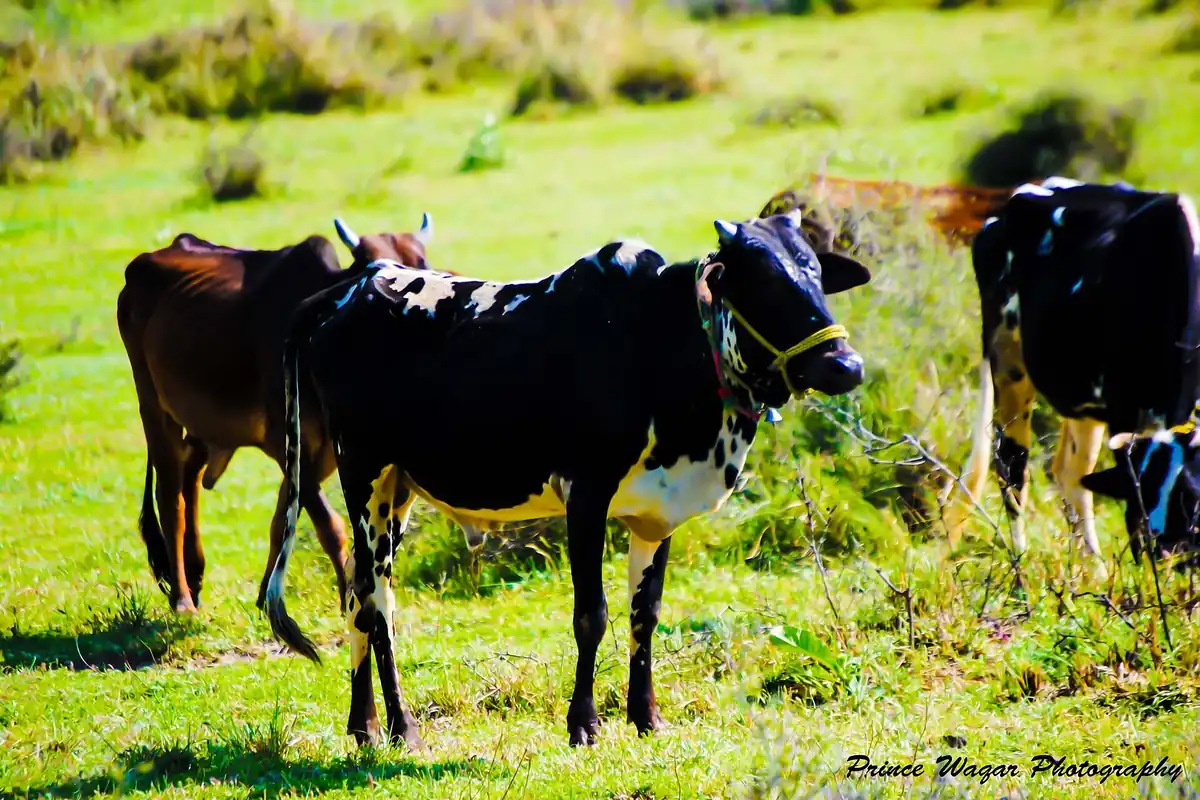
Images in this article are Wikimedia Commons file photographs — Empress Market, Karachi (A.Savin, Free Art Licence), the Karachi skyline (Ktownboy103, CC0), the Karachi container port (A.Savin, Free Art Licence), and cattle in Pakistan (Jalbai / Prince Waqar, CC BY-SA 4.0) — and are not photographs of the forum, its organisers, or its delegates.
Sources
This report is based on reporting, official statements and documents from:
- Arab News Pakistan via Google News — Pakistan eyes boosting global halal market share with $50 billion export ambition (31 Oct 2026; queue 78533a7b1ec4b2b6)
- BizTimes — 1st Pakistan Halal Forum 2026 concludes in Karachi, unveils roadmap for The Intelligent Halal Economy (31 Oct 2026)
- Independent News Pakistan / WealthPK — Halal meat exports can earn Pakistan Rs50bn annually (meat export context: $512m FY24, UAE 39%, Saudi 28%)
- Pakistan TV — Pakistan targets global halal market with reforms to boost meat exports (livestock 251.3m, 63.6% of agri GDP, 14.97% of total GDP)
- Photos: real file photographs (Wikimedia Commons) — Empress Market Karachi, Karachi skyline, Karachi container port, cattle in Pakistan; file photos, not the forum or its delegates
Frequently Asked Questions
What is the $50 billion figure in the halal forum story?
It is the upper end of the forum's own $40-50 billion export opportunity range, reported the same day the forum closed in Karachi. It is an economy-wide ambition spanning food, pharma, cosmetics, modest fashion, tourism, logistics, Islamic finance, and related services — not Pakistan's current halal exports, not a meat-only figure, and not a target with a deadline in the reporting.
What was the 1st Pakistan Halal Forum 2026?
A day-long forum held on Saturday 31 October 2026 at the Pearl Continental Hotel, Karachi, under the theme “The Intelligent Halal Economy”. It was organised by the Halal Development Council, co-organised by the Pakistan Halal Authority and International Halal Certification, with DinarStandard as knowledge partner and the endorsement of the World Halal Council, and it ended with a commitment to become an annual platform.
Why does Pakistan hold under 1% of the global halal market?
That is the paradox organisers stated at the forum: Pakistan is the world's second-largest Muslim population, yet holds less than 1% of a global halal economy put at around $3 trillion. The forum's answer is structural — fragmented certification, raw-material rather than value-added exports, and small firms unable to afford international compliance on their own — rather than a lack of livestock, farms, or demand.
What does “One National Halal Mark, One Standard” mean?
It is the forum's central proposal: a single national halal mark and a single standard that every Pakistani exporter would meet, so a buyer in the Gulf, Malaysia, or Indonesia could recognise a product's halal status without re-checking which of several domestic certifiers stood behind it. At present it is a proposal by the forum's organisers, not yet reported as adopted by the Pakistan Halal Authority or recognised by a major importing authority.
Which sectors and markets did the forum target?
Sectors covered were halal food, pharmaceuticals, cosmetics, modest fashion, halal tourism, logistics, Islamic finance, and technology-driven traceability. Markets named by the Halal Development Council's chairman were buyers in the Gulf Cooperation Council states, Malaysia, Indonesia, and beyond, connected through public-private partnership, innovation, and export facilitation.
What stands in the way of the $40-50 billion opportunity?
Industry reporting lists foot-and-mouth disease, weak animal traceability, uneven slaughterhouse certification, cold-chain and processing gaps, and higher production costs — $5 per kilogram against India's $3.5, at an October 2025 industry meeting. The forum's follow-ups — dedicated Halal Economic Zones, SME support programmes, and investment facilitation — are aimed at those obstacles, but none was reported with a budget, location, or date when the forum closed.