Sindh Growers Demand Rs650 per Maund for Sugarcane and Announce November 4 Protest March in Karachi

Sindh's sugarcane growers have set a date for their next confrontation with the provincial government. The Sindh Abadgar Ittehad (SAI), the growers' body led by Nawab Zubair Talpur, has demanded that the Sindh government fix the sugarcane price at Rs650 per maund, start crushing on time, and fix the wheat support price at Rs5,000 per maund — and it has announced a protest march on November 4 from the Karachi Press Club to the Chief Minister's House to press those demands.
The announcement came at a press conference at the Hyderabad Press Club, held after a meeting of the growers' body and reported on November 2 by The News and carried by AgriInsite. It is, on its face, a short list of demands. But each item on it touches a different pressure point in Sindh's farm economy, and together they explain why growers who have waited through yet another season of late announcements are now putting a date on the calendar instead of waiting for one.
The headline demand is the cane price itself: Rs650 per maund. A maund is 40 kilogrammes, so the demand is Rs650 for every 40 kilogrammes of cane a grower delivers to a mill. SAI wants the Sindh government to fix that price formally. Until the government fixes it, growers say, mills set their own rates — and growers, who cannot store a perishable crop indefinitely or carry it to a distant buyer, take whatever is offered. The demand for a fixed price is therefore not only about the number. It is about who sets the number, and when.
Timing is the second demand, and growers treat it as inseparable from price. Talpur told the Hyderabad press conference that delays in announcing cane prices and starting crushing operations every year cause financial losses to growers. That is a precise complaint, not a general one, and the mechanism he described is worth understanding. When crushing starts late, harvested cane sits. In cold weather, Talpur said, the cane dries out, loses weight, and therefore earns less — because growers are paid on weight. A grower who cuts on time but waits for the mill loses money through no fault of his own, as the crop he grew literally shrinks in the wait.
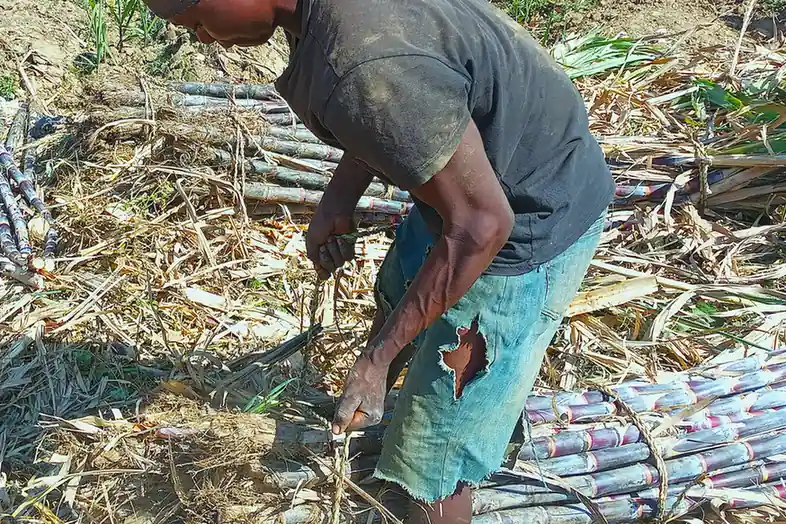
That weight-loss argument also explains why growers link the cane calendar to the wheat calendar. Cane that is cut late, or paid for late, delays everything that follows on the same land, including wheat sowing. SAI raised the same linkage at an earlier meeting in October, when it demanded timely mill operations so that wheat cultivation could begin according to the crop calendar. The November 2 statement does not repeat that sentence in full, but the logic is the same: a late cane season is not a single-crop problem. It pushes the next crop out of its window, and the cost of that delay lands on the same household twice.
The wheat demand: Rs5,000, not a reported Rs4,500
The meeting also discussed the federal government's wheat policy and prices, and here Talpur's statement was framed as a rejection as much as a demand. He rejected reports that the government was considering fixing the wheat price at Rs4,500 per maund, and demanded that it be set at Rs5,000 per maund instead.
Readers should be careful about exactly what that sentence does and does not establish. It does not establish that the government has announced Rs4,500. What Talpur rejected was a reported consideration — a figure said to be under discussion. The demand that is firmly on the record is Rs5,000. The Rs4,500 figure matters because it shows the gap SAI is fighting over: Rs500 per maund between what growers fear the price might be and what they say it must be. On a crop grown at scale, that gap is the difference between a season that covers its costs and one that does not, and SAI clearly decided that the time to argue about it is before any price is fixed, not after.
Wheat is also the crop where the federal and provincial pictures meet. Cane pricing is a provincial matter in Sindh, which is why the cane demand is addressed to the Sindh government. Wheat support pricing is set in a federal policy frame, which is why the wheat discussion in the same meeting was about the federal government's policy. SAI put both demands in one statement because the same grower faces both prices in the same season — and because a protest that only talked about cane would leave half the household budget out of the argument.

Paddy in upper Sindh: the third crop in the statement
Talpur also expressed concern over the price of paddy in upper Sindh, where growers are facing difficulties as paddy is being sold at Rs2,600 per maund. The November 2 report gives no further breakdown for paddy — no demand figure, no district-wise detail, no comparison with last season's price — and this article does not invent one. What the mention establishes is scope: this is not a single-crop protest. Cane is the headline, wheat is the second demand, and paddy is the warning that the same squeeze — a price growers consider too low, announced too late or not at all — is being felt across crops and across the province, from the cane belt to the rice belt of upper Sindh.
That breadth matters for the November 4 march. A protest built on one crop draws one set of growers. A protest that names cane, wheat and paddy draws the whole farm economy of the province, and it gives the march a broader claim to speak for rural Sindh rather than for one lobby. Whether that broader claim holds on the day — who actually marches, from which districts, in what numbers — is something only November 4 itself will show. The announcement, for now, is the claim.
What happens on November 4
The plan announced by SAI is a protest march on November 4 from the Karachi Press Club to the Chief Minister's House. The route itself is the message. Press clubs are where demands are announced; the Chief Minister's House is where they are answered. A march between the two is designed to carry the demands from the place they are spoken to the place they must be decided, in public, on foot, with cameras watching.
Two things are worth watching before the march even begins. The first is whether the Sindh government announces a cane price, or a crushing start, before November 4. An announcement before the march would change the march's character entirely — from a demand for a price into a verdict on a price. The second is whether any mill association or government spokesperson responds to the Rs650 figure in the meantime. The November 2 report carries no government response and no mill response, and this article does not attribute any position to either side beyond what is on the record. Silence from both sides, if it continues, is itself part of the story: growers are marching, in part, because they say they have waited for answers that have not come.
On the day, the questions that will decide whether the march matters are practical ones. How many growers turn out, and from how far? Does the march reach the Chief Minister's House, and does anyone from the government meet it? Does the day end with a date — a price announcement date, a crushing date, a meeting date — or only with a repeat of the demands? Protests in farm politics are often judged by what they extract, not by how loud they are, and SAI's leaders will know that. The Rs650 figure gives the march a clear, testable outcome: either the government moves toward it, or it does not.
Not the first time SAI has demanded Rs650
Regular readers of farm news will notice something familiar about the headline figure. SAI demanded the same Rs650 per 40 kilogrammes at an earlier meeting reported on October 9, alongside a demand for timely mill operations and the closure of flood canals. The repetition is significant, and it cuts both ways. For growers, it shows consistency: this is not a number invented for a protest, but a position the body has held for at least a month. For the government, it is a reminder that the demand has already been on the table for weeks without, on the available reporting, a settlement. A demand repeated is a demand unanswered, and that is precisely the point SAI is making by putting a march behind it now.
The October meeting also shows that SAI's agenda has always been wider than one price. Then, as now, the body linked cane pricing to the timely opening of mills, to water, and to the costs growers face across the season. The November statement is narrower in its list — cane, wheat, paddy, crushing — but it is the same organisation making the same kind of argument: that farm prices are not set in time, and that the delay itself is a cost growers are forced to absorb.
The sugar backdrop: stocks, exports and the shop price
The cane-price fight does not happen in a vacuum. Four days before SAI's statement was reported, on October 29, Deputy Prime Minister Ishaq Dar chaired the Cabinet Committee on Surplus Sugar to review Pakistan's sugar stock position and move towards finalising export guidelines. That meeting, reported in full by TaazaPulse, stressed that exports must support farmers and the industry without disturbing domestic supplies or prices, and ordered robust monitoring against market distortion. The committee's own recent reporting, from a separate October 24 meeting, put the average retail sugar price at Rs141.61 per kilogram in the Pakistan Bureau of Statistics weekly report for the week to October 22, against Rs188.81 a year earlier, with domestic prices described as well below a targeted retail price of Rs155 per kilogram.
Those figures are dated, and they describe a different meeting from SAI's protest announcement — they should not be pasted onto this week's story as if they were newly decided. But they explain the tension at the heart of the cane dispute. Consumers have recently seen sugar prices well below last year's levels, and the federal government has framed its sugar policy around protecting those consumers. Growers, meanwhile, say the price they receive for their cane does not reflect a fair share of that chain. Both claims can be true at once: a retail price can fall while the farm-gate price still leaves growers short, because the margin between the field and the shop is where mills, traders and costs sit. SAI's Rs650 demand is, in effect, an argument about that margin — about who gets what between the cane field in Sindh and the sugar bowl in a Karachi kitchen.

That is also why the export debate matters to growers even though SAI's statement does not mention exports. When mills can sell sugar abroad, they clear stocks and free cash to buy cane and pay for it. When exports are held back, mills sit on stocks and growers feel the squeeze in delayed payments. The Dar committee's monitoring instruction — tracking stocks, prices and supply so that export decisions do not create shortages or spikes — is the federal side of the same problem SAI is raising from the provincial side: that the system between field and market needs rules that work in practice, not only on paper. A grower waiting for a cane price and a committee reviewing sugar stocks are looking at opposite ends of the same chain.
What growers, mills and the government each face
It is worth stating, plainly and without taking a side, what each party in this dispute is dealing with — because the Rs650 figure will be argued about as if only one side's costs were real, and they are not.
Growers face the most immediate risk. Their crop is perishable, their costs are paid up front — seed, water, fertiliser, labour, transport — and their income arrives only when the mill buys and pays. A late price announcement leaves them negotiating blind. A late crushing start shrinks their crop in the cold. A low price leaves them short on the next season's inputs. And because the same household grows wheat and paddy alongside cane, a bad cane season is rarely a single-crop loss.
Mills face a different set of pressures, and the November 2 report does not carry their response — so this paragraph states the general position, not any claim made in this week's reporting. Mills buy cane, crush it, hold sugar stocks, and sell into a market where the government watches retail prices closely and where export openings are decided by committee. Their margins depend on the cane price, the sugar price, and the timing of both. A cane price they consider too high, set without regard to the sugar price they can realise, squeezes them; a cane price set too low, or paid too late, squeezes growers. That tension is structural, not personal, and it is why cane pricing disputes recur every season in both Sindh and Punjab.
The Sindh government faces the task of fixing a price that both sides can live with, and doing it in time for the crushing season to start on schedule. That is a harder task than it looks from outside: set it too low and growers protest, as they are now threatening to do; set it without regard to market conditions and mills push back or delay payments; set it late and the weight-loss problem Talpur described has already done its damage. The November 4 march is, among other things, a deadline imposed from outside on a decision the government has, on growers' account, been slow to make.
What to watch next
Between now and November 4, four developments would each change this story. First, any announcement by the Sindh government of a cane price, a crushing date, or both. Second, any response from a mill association or the Pakistan Sugar Mills Association to the Rs650 figure. Third, any federal word on the wheat support price — whether the Rs4,500 figure Talpur referred to is confirmed, denied, or replaced by a formal announcement. Fourth, any indication of the march's scale: district-level mobilisation, transport arrangements, or statements from other growers' bodies joining or distancing themselves from SAI's call.
After November 4, the story becomes about outcomes. If the march produces a meeting, a date, or a price, the next article will report it as a new development with its own verification. If it produces only a restatement of demands, that too is news — it would mean the province's growers and its government are still talking past each other as the crushing season advances. And if crushing begins while the price is still unfixed, growers' original complaint — mills setting their own rates while the government stays silent — will have been demonstrated in practice, whatever anyone says about it.
For households that do not grow cane, the stakes are still real. The cane price feeds into the sugar price, the wheat price feeds into the flour price, and the paddy price feeds into the rice price. Farm-gate disputes in Sindh have a way of arriving in Karachi kitchens weeks later, in small increments that are easy to miss until they add up. That is why a protest march announced at a Hyderabad press conference deserves more than a paragraph: it is an early signal about the prices that will shape the winter's food bills.
What is not yet known — and what this article does not claim
Honesty about the limits of this report is part of the report. The November 2 account does not say what the Sindh government's current position on the cane price is, and this article does not guess it. It does not say when crushing will start this season, and no date is claimed here. It does not carry a mill response, a government response, or a figure for what mills are currently paying — none appears in the reporting, and none is invented to fill the gap. It does not say how many growers will march on November 4, which districts they will come from, or whether the march will be permitted to reach the Chief Minister's House. Those are November 4 facts, and they will be reported when they happen.
Similarly, the background figures in this article are all dated to their own reporting. The October 24 committee's retail sugar figures belong to October 24. The October 9 SAI meeting belongs to October 9. The Dar committee's October 29 stock review belongs to October 29. None of them is presented as this week's position, and readers who see social media posts attaching a new price or a new date to any of those meetings should treat them with caution until a fresh, dated announcement appears.
What is firmly established, on the November 2 reporting, is this: Sindh Abadgar Ittehad, under Nawab Zubair Talpur, has demanded Rs650 per maund for sugarcane, Rs5,000 per maund as the wheat support price, timely crushing, and attention to paddy prices in upper Sindh — and it has announced a protest march on November 4 from the Karachi Press Club to the Chief Minister's House to press those demands. That is the story. Everything else — the government's answer, the mills' answer, the march itself — is still to come, and TaazaPulse will update this story when it does.
Figures and quotations in this article are taken from The News reporting of the Sindh Abadgar Ittehad press conference at the Hyderabad Press Club, as carried by AgriInsite on November 2, 2026. The October 9 SAI meeting and the October 24 and October 29 committee figures are attributed to their own dates and are not presented as figures from this week's announcement. No government or mill response appears in the November 2 reporting, and none is claimed here.
Sources
This report is based on reporting, official statements and documents from:
- AgriInsite (The News reporting) — Growers demand sugar cane price be fixed at Rs650 per maund (2 Nov 2026)
- The News International — original reporting of the SAI Hyderabad Press Club press conference (2 Nov 2026, via AgriInsite)
- AgriInsite — SAI October meeting: Rs650 demand and timely mill operations (9 Oct 2026)
- Images: sugarcane field in Kot Addu — Wikimedia Commons (CC0); worker bundling cane — file photo; wheat fields in Punjab — file photo; sugar cubes — file photo
Frequently Asked Questions
What exactly are Sindh's growers demanding?
Four things, announced by the Sindh Abadgar Ittehad (SAI) at a Hyderabad Press Club press conference and reported on November 2, 2026: a sugarcane price fixed at Rs650 per maund, timely commencement of crushing, a wheat support price of Rs5,000 per maund, and attention to paddy prices in upper Sindh, where growers say paddy is selling at Rs2,600 per maund. SAI president Nawab Zubair Talpur also rejected reports that the government was considering a wheat price of Rs4,500 per maund — that figure is a reported consideration he opposed, not an announced price.
Who announced the demands, and when is the protest?
The Sindh Abadgar Ittehad, led by its president Nawab Zubair Talpur, announced the demands after a meeting of the growers' body, at a press conference at the Hyderabad Press Club. The protest is a march on November 4, 2026, from the Karachi Press Club to the Chief Minister's House in Karachi. The march has not happened yet — this article reports the announcement, not the outcome, and no turnout figure or permission outcome is claimed.
Why does late crushing cost growers money?
Because growers are paid on weight, and cane left waiting loses weight. Talpur said delays in announcing prices and starting crushing cause financial losses every year: cane harvested late, or left standing into cold weather, dries out, so the same crop weighs less and earns less when it finally reaches the mill. Late crushing also pushes back the next crop on the same land, including wheat sowing, so one delay can cost the same household twice in one season.
Has the Sindh government fixed the cane price, or responded?
Not in the reporting available for this story. The November 2 report carries no Sindh government response, no mill response, no crushing start date, and no figure for what mills are currently paying — and none is claimed in this article. The Rs650 figure is SAI's demand, not an announced price. If the government announces a price or a crushing date before November 4, that announcement will change the march's character from a demand into a verdict, and TaazaPulse will report it as a new development.
Why is wheat part of a sugarcane protest?
Because the same household grows both crops in the same season. Cane pricing is a provincial matter in Sindh, which is why the cane demand is addressed to the Sindh government, while wheat support pricing sits in a federal policy frame. SAI put both demands in one statement — plus the paddy concern in upper Sindh — because a protest that only talked about cane would leave half the farm budget out of the argument. The wheat demand is Rs5,000 per maund; the Rs4,500 figure is one Talpur said was reportedly under consideration and rejected.
How does this connect to the sugar price in shops?
Through the chain from field to shop shelf. On October 29, 2026, Deputy Prime Minister Ishaq Dar chaired the Cabinet Committee on Surplus Sugar, which stressed that exports must support farmers and the industry without disturbing domestic supplies or prices, and ordered monitoring against market distortion. A separate October 24 committee report put the average retail sugar price at Rs141.61 per kilogram for the week to October 22, against Rs188.81 a year earlier. Those are dated figures from other meetings, not this week's prices — but they show the tension: consumers have recently paid less for sugar while growers say the price they receive for cane still leaves them short, because the margin between field and shop is where mills, traders and costs sit.