Three Tankers Ablaze in the Strait of Hormuz — Iran Claims Mines, US Disputes It
A vessel is on fire in the Strait of Hormuz, and Iran's Revolutionary Guards say three oil tankers exploded after striking naval mines in the world's most important oil chokepoint — a claim the United States military flatly disputes and that no independent source has yet confirmed. What is certain, on Thursday 29 October 2026, is that Britain's maritime trade agency has logged a burning ship off the coast of Oman; everything else — how many vessels are involved, what hit them, and whether anyone on board is hurt — remains contested, and the competing accounts are themselves part of the story.
The United Kingdom Maritime Trade Operations (UKMTO) said the master of one vessel reported seeing another vessel on fire about nine nautical miles — roughly 17 kilometres — north of Khasab, a town on Oman's Musandam Peninsula that juts into the strait. UKMTO passed on the report without identifying the burning vessel, without giving a cause, and without any information about the crew's condition or the scale of the damage. It was, in the agency's own terms, a sighting by a third party, not a verified casualty report.
Shortly afterwards, Iran's Islamic Revolutionary Guard Corps (IRGC) Navy issued a statement carried by Iranian state media saying that three oil tankers had exploded and caught fire after striking naval mines. According to the IRGC account, the incidents happened over the preceding 24 hours as the tankers tried to leave through what Tehran calls an unauthorised southern route of the strait. The statement said the vessels had switched off their radar and navigation systems and ignored repeated warnings from the IRGC Navy before entering the mined route, and that the damaged tankers were left stranded along the waterway's southern coast. The IRGC warned maritime operators that unauthorised routes through the strait are mined, said the owners and crews of the vessels bore responsibility for using them, and urged shipping companies not to rely on United States Central Command (CENTCOM) statements about safe passage.
The American response was a direct contradiction. CENTCOM said the Iranian claims that commercial vessels are hitting sea mines are false, and that United States forces have cleared the internationally recognised transit routes through the strait, which it said thousands of commercial vessels continue to use safely. Washington has encouraged commercial shipping to use a southern lane through the waterway, which President Donald Trump declared free of mines at the end of August. The IRGC statement, by contrast, treats that same southern corridor as an unauthorised route that Tehran has mined.
That contradiction is why Thursday's incident cannot yet be reported as a settled fact. The Associated Press said it could not immediately verify Iran's claims. No source has identified any of the three tankers the IRGC says were hit, no casualty figures have been published by any side, and no connection has been established between the single burning vessel reported to UKMTO and the three tankers in the Iranian account. It is possible the UKMTO sighting is one of the three; it is equally possible it is a separate incident. Until a vessel is named, a crew is accounted for, or independent imagery emerges, the honest summary is: one confirmed sighting of a burning ship, one Iranian claim of three mined tankers, and one American denial.
Why this stretch of water matters so much
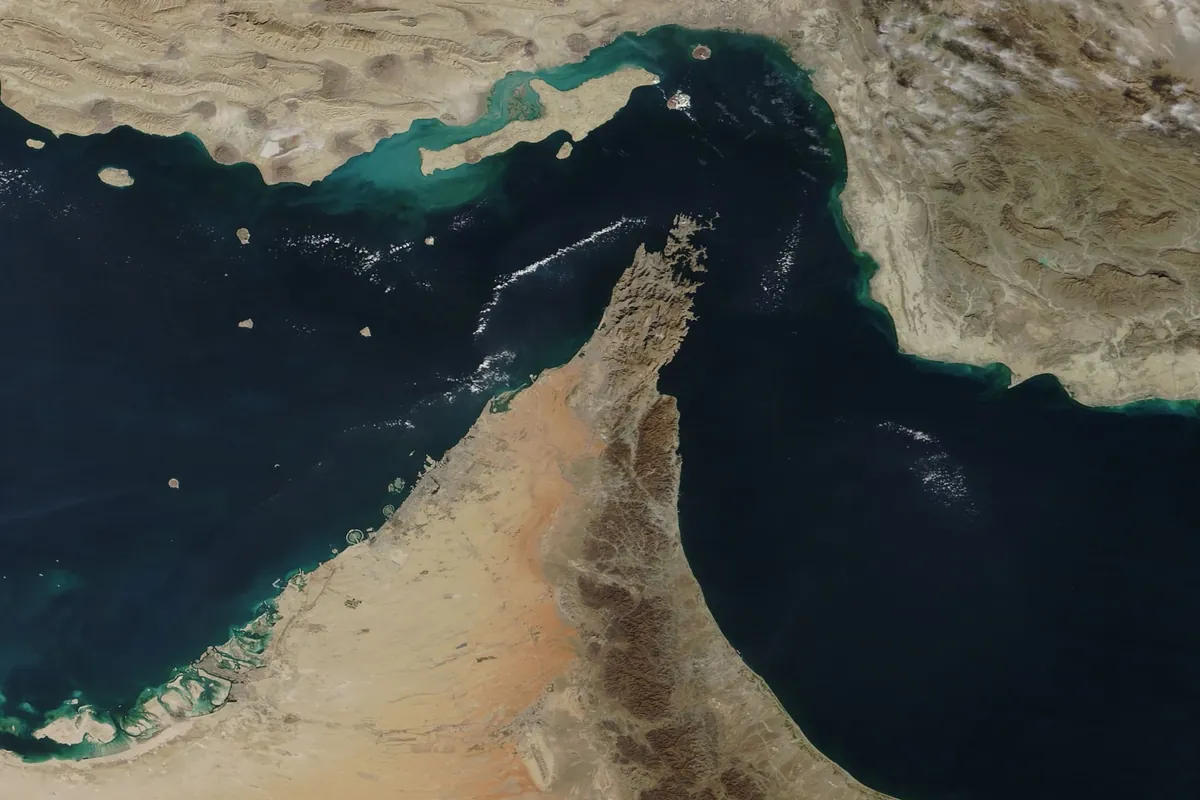
The Strait of Hormuz is a narrow channel between Iran and the Musandam Peninsula of Oman, linking the Persian Gulf to the Gulf of Oman and the open sea. Roughly a fifth of the world's petroleum transit passes through it, which is why any suggestion that it has become unsafe moves oil markets within hours and why every incident there is read in capitals far beyond the Gulf. The strait has been the focus of repeated confrontations this year: after a war that began in February 2026 with American and Israeli attacks on Iran, Tehran moved to control passage through the waterway, and shipping through it has been repeatedly disrupted since.
The location in Thursday's UKMTO report sharpens the point. Khasab sits on the Musandam Peninsula, the Omani promontory that forms the strait's southern shore; a vessel nine nautical miles north of it is in the narrowest, most congested part of the transit corridor, where inbound and outbound lanes run close together and where a stricken ship is a hazard to every vessel behind it. UKMTO itself is the British Royal Navy's maritime trade information service: it does not investigate incidents, it relays what masters at sea report, and its alerts are the shipping industry's first warning system. That is why its wording matters — a "vessel on fire" reported by another ship's master is a fact about a sighting, not a finding about a cause, and Thursday's alert deliberately stopped there.
The legal and practical argument over the strait has been running all year. Iran requires vessels to contact its authorities and travel along specified routes, and the Revolutionary Guards maintain that other routes are mined. The United States, which enforces its own naval presence in the area and has recently escorted tankers through the stretch where the burning ship was sighted, insists the internationally recognised lanes are clear. On 17 June, Tehran and Washington signed a memorandum of understanding brokered by Pakistan; under its fifth article, according to the Iranian account, Iran took responsibility for reopening and managing the strait. Tehran later said Washington undermined that arrangement with a naval blockade, and declared the chokepoint closed to all traffic. Thursday's claims and counter-claims are the latest round of that unresolved dispute, not a new one.
What it means for oil — and for Pakistan
Market reports put Brent crude near 112 dollars a barrel after the reports, a level not seen since mid-May, as traders priced in a fresh risk premium for Gulf shipping. The move matters in Pakistan more directly than in most countries, because Pakistan now revises petrol and diesel prices every day on the basis of international benchmarks: today's domestic revision put petrol at 377.91 rupees a litre and high-speed diesel at 399.82 rupees, and any sustained rise in crude or freight costs feeds into the next day's calculation. No new Pakistani price has been announced in response to Thursday's incident, and a single day's market move does not by itself set tomorrow's rate — but the mechanism means Gulf disruptions reach Pakistani pumps faster than they used to. Pakistan meets most of its oil needs through imports shipped by sea, and tankers bound for Karachi and Port Qasim sail waters that connect directly to the Gulf corridor — so a closure scare in the strait is, for Pakistani households, not a distant headline but a line item in the next fuel notification.
The shipping picture is equally exposed. Insurance and security costs for transiting the strait have risen sharply through the year, and many vessels now travel either under naval escort or with their tracking systems switched off — the very practice the IRGC cited in its statement. Maritime security analysts note that attacks on ships in the strait are running at their highest level since the war began, according to the Washington Institute for Near East Policy, and shipping data provider Kpler has recorded falling oil exports through the waterway in recent weeks. Thursday's incident, whatever its precise facts turn out to be, lands in a market already primed to treat the strait as dangerous.
The wider picture: diplomacy and dismissal in Washington
The Hormuz reports arrived alongside signs of parallel movement in Washington. Reports said Vice President JD Vance has contacted Iran's security chief Mohsen Rezaei about negotiations, even as the United States is widely seen to be weighing fresh strikes after next week's midterm elections. In the same week, Defence Secretary Pete Hegseth dismissed the Pentagon's top military planner for the Iran war, Lieutenant General Brett Sylvia, reportedly over leaked information. None of that changes the facts at sea, but it frames the incident: a war that paused in April after forty days of fighting has never fully settled into peace, and the strait's status has remained its most combustible loose end.
What to watch next
Five things will settle Thursday's story. First, whether UKMTO or another maritime authority identifies the burning vessel and reports on its crew. Second, whether Iran names the three tankers it says were mined, or produces imagery of them. Third, whether CENTCOM or an independent shipping source confirms or rebuts the mine claim with evidence of its own. Fourth, whether any oil spill or environmental damage is reported from the site. And fifth, whether shipping through the strait is interrupted in the hours ahead — the surest market signal of how seriously operators are taking the claims. TaazaPulse will update this report as any of those answers emerge; until then, the competing claims stand as claims, and the single confirmed fact remains a ship on fire off Khasab.
Sources for this report: United Kingdom Maritime Trade Operations alerts and the Associated Press account of the UKMTO report; the Islamic Revolutionary Guard Corps Navy statement as carried by Tasnim News Agency and Iranian state media; United States Central Command's rejection of the mine claims; market reporting on Brent crude; and the June 2026 Pakistan-brokered memorandum of understanding as described by Tasnim.
Sources
This report is based on reporting, official statements and documents from:
- United Kingdom Maritime Trade Operations alerts
- Associated Press (via WTOP/worldbeat reporting)
- Tasnim News Agency — IRGC Navy statement
- United States Central Command response
- DW — ship reported on fire off Oman
Frequently Asked Questions
What happened in the Strait of Hormuz on 29 October 2026?
Britain's maritime trade agency, UKMTO, reported a vessel on fire about nine nautical miles (17 kilometres) north of Khasab, Oman, after the master of another vessel sighted it. On the same day, Iran's Revolutionary Guards Navy said three oil tankers had exploded and caught fire after striking naval mines. The two reports have not been connected to each other, and the Iranian claim has not been independently confirmed.
What exactly does Iran claim?
The IRGC Navy statement, carried by Iranian state media, says three oil tankers struck mines over the preceding 24 hours while trying to leave through what Tehran calls an unauthorised southern route of the strait. It says the tankers had switched off their radar and navigation systems, ignored IRGC warnings, and were left stranded along the waterway's southern coast. It warns that unauthorised routes are mined and holds the vessels' owners and crews responsible.
What does the United States say?
United States Central Command says the Iranian claims that commercial vessels are hitting sea mines are false, and that American forces have cleared the internationally recognised transit routes, which it says thousands of commercial vessels continue to use safely. Washington has encouraged shipping to use a southern lane that President Donald Trump declared free of mines at the end of August — the same corridor Tehran describes as unauthorised.
Has any of this been independently confirmed?
No. The Associated Press said it could not immediately verify Iran's claims. No source has named any of the three tankers, no casualty figures have been published by any side, and no connection has been established between the single burning vessel reported to UKMTO and the three tankers in the Iranian account. Until a vessel is named or independent imagery emerges, the claims remain claims.
Why does the Strait of Hormuz matter so much?
Roughly a fifth of the world's petroleum transit passes through the narrow channel between Iran and Oman's Musandam Peninsula. After a war that began in February 2026 with American and Israeli attacks on Iran, Tehran moved to control passage through the waterway, and a Pakistan-brokered memorandum of understanding signed on 17 June assigned Iran responsibility for reopening and managing the strait, according to the Iranian account. The dispute over which routes are authorised is what Thursday's claims are about.
What does this mean for Pakistan?
Pakistan now revises petrol and diesel prices daily on international benchmarks, so a sustained crude spike reaches pumps quickly: today's revision put petrol at 377.91 rupees a litre and high-speed diesel at 399.82 rupees. Market reports put Brent crude near 112 dollars a barrel after Thursday's reports, a level not seen since mid-May. No new Pakistani price has been announced in response to this incident, and a single day's market move does not by itself set tomorrow's rate.