Pakistan's Subnational Polio Drive: 24 Million Children, 97 Districts, 2-8 November
Pakistan's next polio campaign will run from Monday 2 November to Sunday 8 November 2026, and it will be a subnational round: teams will visit homes in 97 selected districts, not in every district of the country, with the aim of vaccinating more than 23.9 million children under the age of five. The dates, the district count and the target figure come from the National Emergency Operations Centre (NEOC) for polio eradication, which announced the round on 19 October. This article is a preview of that round, written while preparations are still under way, not a report that the campaign has already started: the door-to-door work begins on 2 November.
The distinction matters, because the campaign's design is the story. A nationwide round tries to reach every child under five in the country at once. A subnational round concentrates on the districts where the risk is highest, where environmental surveillance has found poliovirus, where past rounds have missed children, or where the virus has a route back in through movement across the border. The NEOC's announcement named all districts of Karachi as included, a significant detail after the city's first polio case in almost two years, and said the round would be synchronised with Afghanistan, the only other country in the world where wild poliovirus transmission has never been stopped.
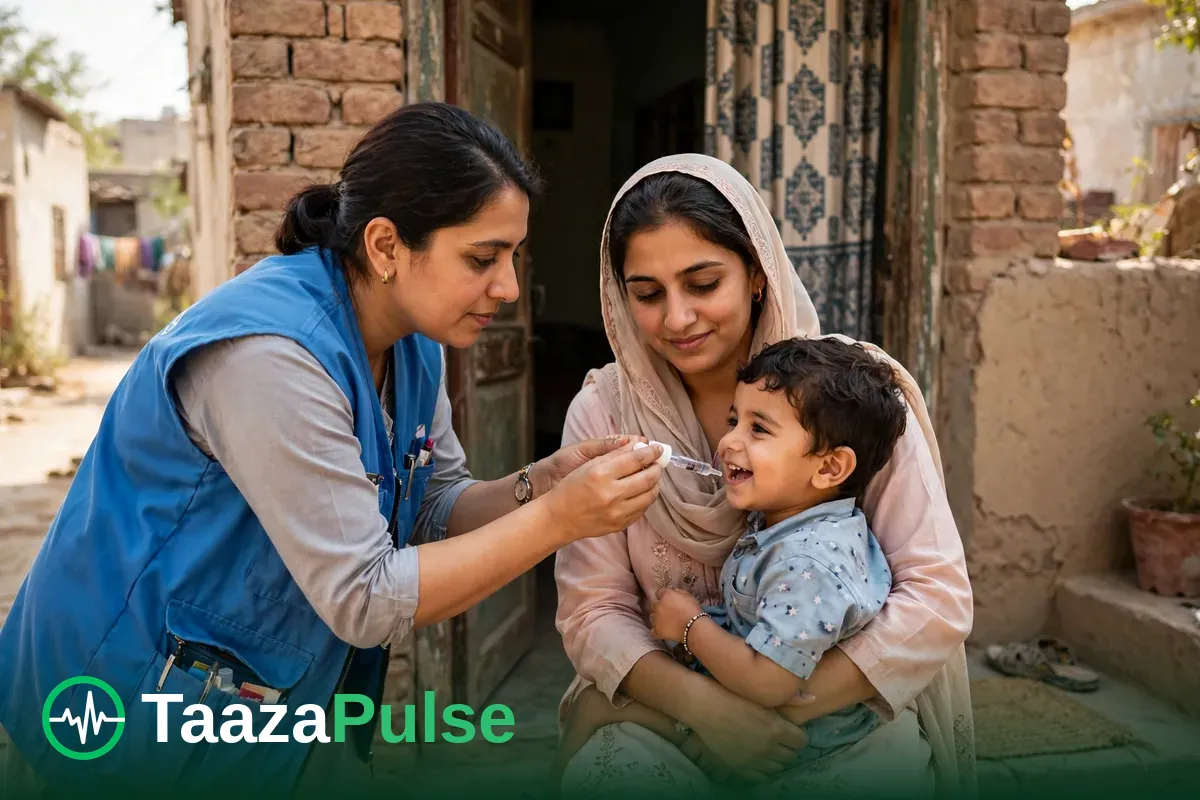
For parents in the 97 districts, the practical shape of the week is familiar. Frontline polio workers will go door to door and give two drops of oral polio vaccine to every eligible child. The programme's rule, repeated in every round, is that every child under five should get the drops in every campaign, including newborns and children who are unwell, and including children who were vaccinated in the last round. Polio has no cure, but it can be prevented, and repeated doses are how immunity is built and kept up in a population where the virus is still circulating. Parents who are not at home when a team calls, or whose child is travelling during the week, can seek the drops at a health facility or through the programme's helpline, 1166, which the programme lists as its public contact number.
The reported provincial breakdown shows where the effort will be concentrated. According to figures reported by the Associated Press of Pakistan (APP) on the day of the NEOC announcement, Punjab will cover 13 districts with a target of more than 9.278 million children, Sindh will cover 20 districts with more than 6.883 million, Khyber Pakhtunkhwa will cover 27 districts with more than 4.808 million, and Balochistan will cover 31 districts with more than 2.217 million. Islamabad is listed at more than 447,000 children, three districts in Gilgit-Baltistan at more than 153,000, and two districts in Azad Jammu and Kashmir at more than 183,000. Those reported figures add up to roughly 23.97 million, consistent with the NEOC's headline figure of more than 23.9 million, though readers should note that the NEOC's own published release carried the dates, the 97 districts and the headline target, while the province-by-province split was reported by APP rather than carried in that release.
The round is the next step in a year of unusually intensive campaigning. In 2026 Pakistan has already run four large-scale nationwide campaigns, which the NEOC says protected more than 45 million children multiple times, alongside smaller targeted oral and injectable vaccination activities in high-risk areas. In September, a subnational campaign protected more than 29.3 million children. The November round is therefore not a one-off push but the fifth major effort of the year in a programme that is trying to close the last immunity gaps before the virus can find another foothold. The scale of that effort is easy to lose sight of: a single nationwide round in Pakistan involves hundreds of thousands of frontline workers, and even a subnational round of 24 million children is larger than the entire child population of most countries.
The reason the programme cannot afford a gap year is visible in this year's case count. Pakistan has confirmed seven cases of wild poliovirus in 2026, five in Khyber Pakhtunkhwa and two in Sindh, according to the NEOC. The most recent was confirmed on 19 October: a six-month-old boy from Union Council Jamali Colony in Karachi East, detected through the national polio surveillance network and confirmed by the Regional Reference Laboratory for Polio Eradication at the National Institutes of Health in Islamabad. It was Karachi's first reported case since December 2024, and the NEOC said a comprehensive investigation had been launched, with the programme analysing the best science-based response, including targeted vaccination and support to strengthen routine immunisation. The child was reported to have been malnourished, a reminder that the children most at risk from polio are often the children with the least access to health care in general.
Against that, the long trend is one of extraordinary progress, and it is worth stating plainly because it explains why the programme believes eradication is achievable rather than aspirational. Pakistan recorded an estimated 20,000 polio cases a year in the early 1990s. It recorded 31 cases in 2025, and seven so far in 2026. That is a reduction of about 99.8 per cent from the early-1990s level, a figure cited in World Polio Day reporting on 24 October. The same reporting noted that environmental samples testing positive for poliovirus have fallen sharply, and that the virus was detected in far fewer districts in 2026 than in 2025. None of that means the job is done: seven cases, and a virus that can circulate silently in sewage before it paralyses a child, are exactly why the November round exists. But it does mean the programme is operating in the endgame, where the remaining work is finding missed children rather than building a system from scratch.
Preparations for the November round were reviewed at the top of the health system on Thursday 29 October, when Federal Secretary for National Health Services Momin Agha visited the NEOC in Islamabad. According to reporting of the visit, he received a detailed briefing on the current polio situation, progress in eradication activities, operational planning and measures to strengthen vaccination coverage, including coordination between federal and provincial health authorities, mobilisation of frontline teams, and strategies to ensure that every eligible child receives the drops. He reaffirmed the government's commitment to eliminating polio, stressed coordinated efforts, effective monitoring and accountability, and highlighted the need to address operational challenges, engage communities and build public trust, particularly in areas where children remain at risk. That language — monitoring, accountability, trust — is the language of a programme that knows its biggest remaining problems are operational rather than scientific. The vaccine works. The challenge is reaching the child.
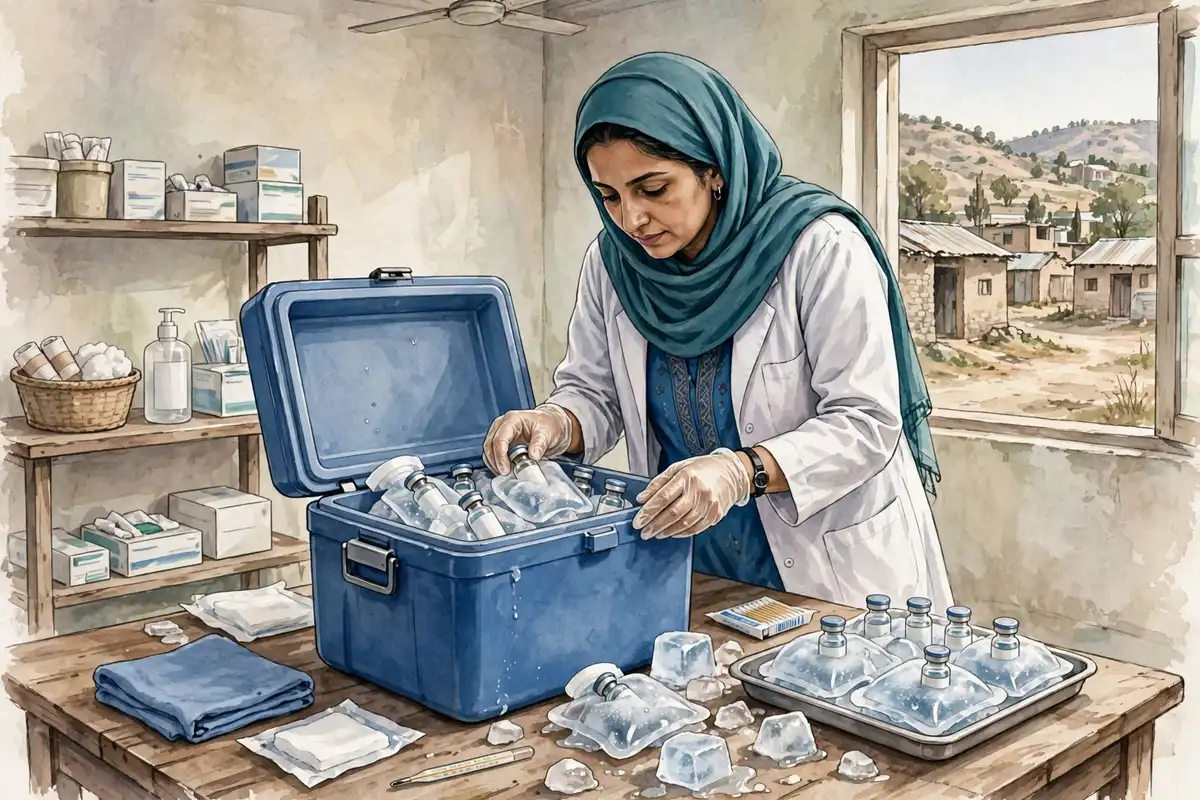
Reaching the child is harder than it sounds, and the programme's own history in 2026 shows why. On 18 May, two police officers guarding vaccination teams were killed in Bajaur as a campaign began to reach more than 19 million children across 79 districts. In September, two more police constables protecting a vaccination team were killed in Balochistan. Attacks on teams, security conditions that close off whole areas, and parental refusals all leave children unprotected, and the programme's independent monitoring has in past years found hundreds of thousands of children missed in a single round. The November round will again rely on police protection for teams in sensitive areas, on community engagement to reduce refusals, and on the digital tracking and strengthened environmental surveillance that programme leaders have described as part of this year's approach. None of those measures guarantees a perfect round, but each addresses a specific way in which children were missed before.
The cross-border dimension is inseparable from the November round, and it is why synchronisation with Afghanistan matters. The two countries share a long, porous border, and the virus does not respect it: families move, children travel, and a chain of transmission interrupted on one side can be reseeded from the other. Afghanistan has recorded far more cases than Pakistan in 2026, with figures cited in October reporting putting its total at 42 wild poliovirus cases against Pakistan's six or seven, depending on the reporting date. That asymmetry is a warning, not a comfort: as long as transmission continues in Afghanistan, Pakistan's border districts, and the cities that receive travellers from across the border, remain at risk. Coordinated rounds, in which both countries vaccinate in the same week, are designed to close that window, so that a child protected in Karachi is not re-exposed by a chain that started in Kandahar or Nangarhar.
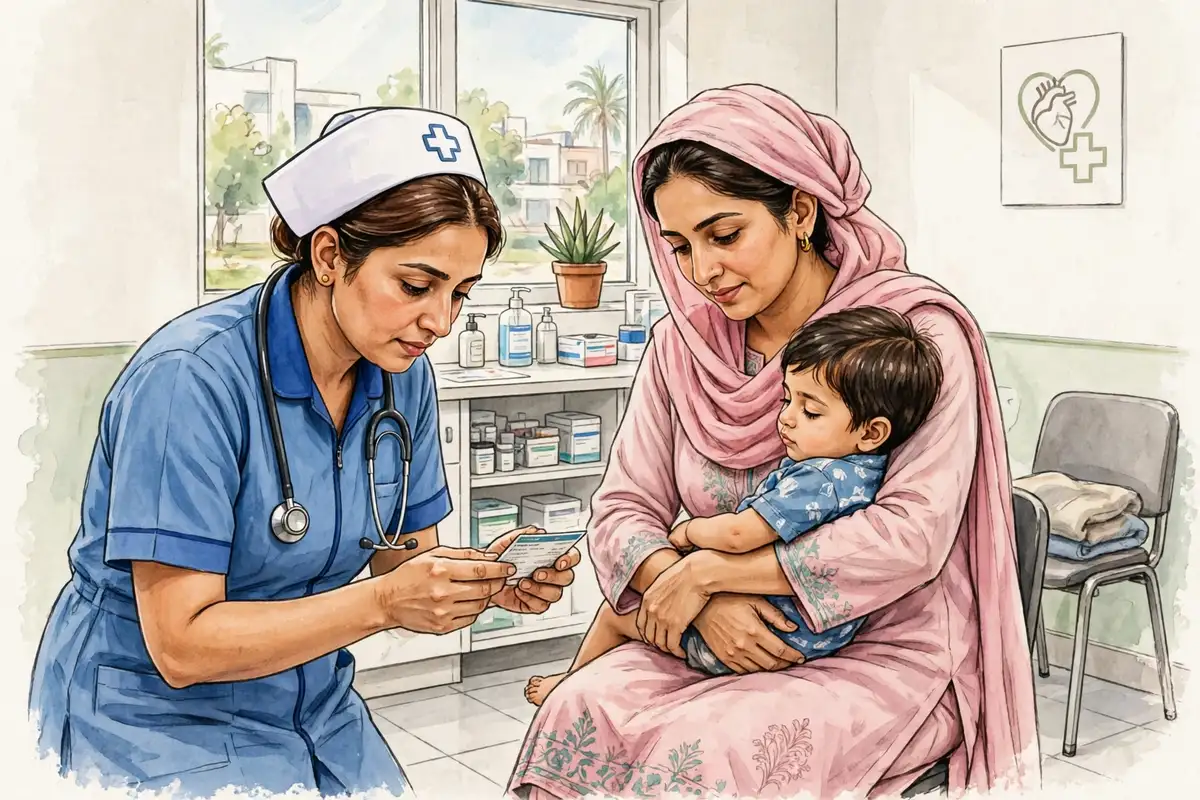
There is also a routine immunisation story behind the campaign story, and parents should not confuse the two. Campaign drops are extra doses, given to every child under five regardless of their routine record, because they raise population immunity quickly and uniformly. Routine immunisation, given at health facilities according to the national schedule, is the foundation that keeps a child protected between campaigns. The NEOC's statement on the Karachi case explicitly linked the two, saying the programme was looking at targeted vaccination and support to strengthen routine immunisation. A child who gets campaign drops but misses routine doses is better protected than a child who gets neither, but the programme's goal is both: campaign rounds to stop transmission now, and a routine system strong enough that transmission cannot restart later.
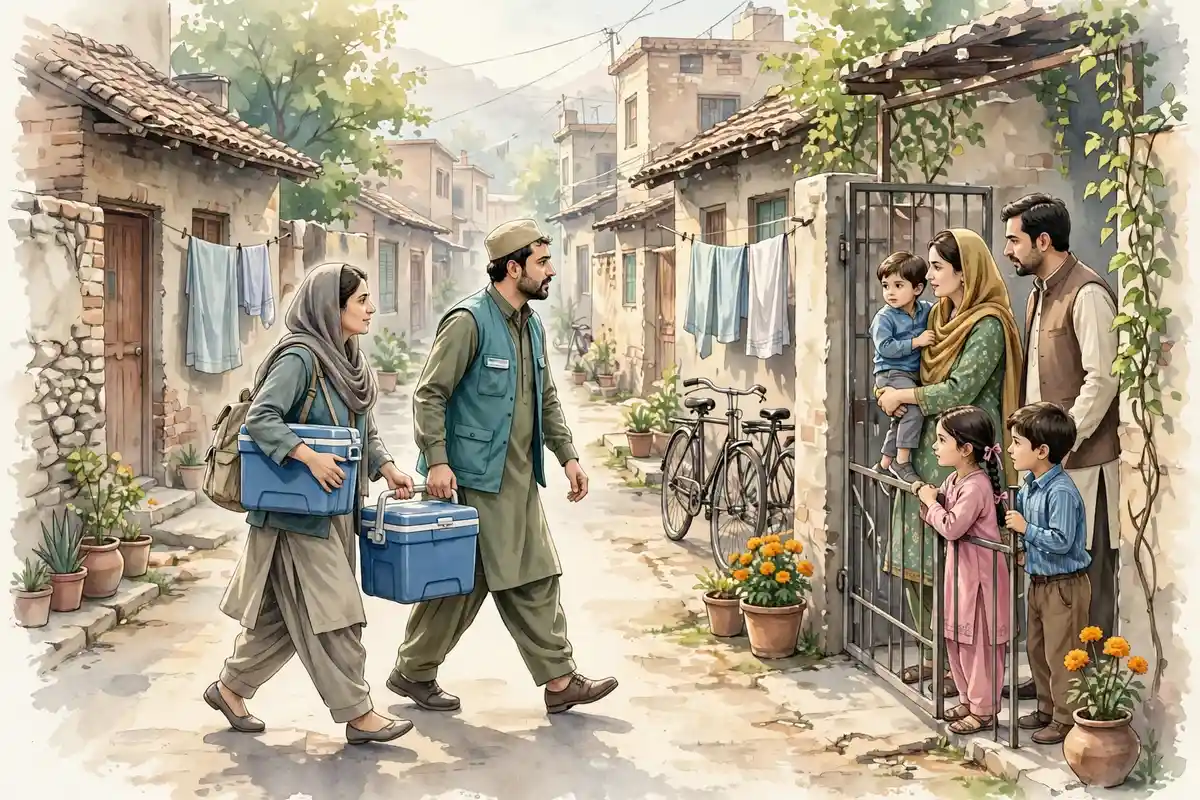
For households in the 97 districts, the week of 2 to 8 November will follow a pattern that most Pakistani families know well. Teams will knock during the day, ask for every child under five in the household, and give two drops. The visit takes seconds. Parents are asked to keep the child's vaccination card ready where they have one, to tell the team about any child who is away from home, and to make sure children who are visiting relatives, travelling, or staying elsewhere are also brought to the team or to a health facility. Children who miss the team during the week are not lost to the round: catch-up arrangements, transit points at bus stops, railway stations and border crossings, and health-facility vaccination are part of how the programme tries to reach mobile and travelling children, and the helpline 1166 is the programme's published route for families who need to find their nearest point.
For households outside the 97 districts, the message is different, and it is important not to misread the subnational design as neglect. If a district is not in the November round, it is because the programme's surveillance and risk assessment did not place it in the highest-risk group for this round, not because its children do not need protection. Those children remain protected by routine immunisation, and they will be included in the next nationwide round. Parents in non-included districts who are unsure about their child's routine doses should check the vaccination card and visit a health facility rather than waiting for a campaign team that is not scheduled to come. The programme has not published a full list of the 97 districts in its online release, so families who are unsure whether their district is included should ask their local health office or call 1166 rather than relying on a forwarded list.
The November round also carries a political and financial context that will determine whether the endgame holds. The Global Polio Eradication Initiative, which funds and coordinates the global effort with partners including the World Health Organization, UNICEF, Rotary and the Gates Foundation, cut its 2026 operating budget and approved a smaller budget for 2027, while surveillance funding remains at a reduced level. Programme leaders have warned that the endgame depends on finding missed and mobile children, countering refusals, protecting vaccinators, keeping environmental and acute flaccid paralysis surveillance strong, and sustaining donor funding and cross-border coordination. A successful November round, with high coverage in the 97 districts and no new case emerging from a missed pocket, would strengthen the case for that funding. A round with large numbers of missed children would do the opposite, and would leave the virus a route into 2027.
What success looks like in November is therefore measurable, and readers should hold the programme to it. The first measure is coverage: how many of the targeted 23.9 million children actually received drops, and how many were recorded as missed, by district. The second is the refusal count: how many households declined, and where. The third is the surveillance picture in the weeks after the round: whether environmental samples continue to fall, and whether any new case is confirmed. The fourth is the cross-border picture: whether Afghanistan's synchronised round achieved comparable coverage, since Pakistan's gains are only as durable as the region's. The NEOC has published those kinds of figures after previous rounds, and TaazaPulse will report them when they are released rather than estimating them in advance.
Until then, the responsible summary is short. Pakistan's next polio round runs from 2 to 8 November 2026 in 97 districts, targeting more than 23.9 million children under five, with all Karachi districts included and the round synchronised with Afghanistan. It follows four nationwide rounds and a September subnational round in 2026, and it comes after seven confirmed cases this year, the latest in Karachi East. Preparations were reviewed at the NEOC on 29 October. The drops are free, they are given door to door, and every child under five in the included districts should receive them, including children who were vaccinated before. That is the whole of the verified picture at publication, and it is enough for any parent in an included district to know what to do next week: be home, or be findable, when the team knocks.
Dates, district counts and target figures in this article are taken from the NEOC's 19 October 2026 announcement and APP reporting of it. The provincial breakdown is the reported APP breakdown, not a figure carried in the NEOC's online release. Where this article notes that a detail has not been published, that reflects the sources available at publication.
Sources
This report is based on reporting, official statements and documents from:
- NEOC Pakistan — Karachi East reports Pakistan's seventh polio case of 2026; next round 2-8 Nov in 97 districts (19 Oct 2026)
- Daily Balochistan Times (APP) — Polio vaccination drive to cover 23.9 mln children from Nov 2
- Medical News Pakistan — World Polio Day 2026 puts Pakistan's polio fight in focus
- Lead Pakistan — Secretary Health reviews polio eradication efforts at NEOC (29 Oct 2026)
- PakEra — Polio Campaign 2 to 8 November 2026: 97 Districts, 24m children
Frequently Asked Questions
When is Pakistan's next polio campaign, and where does it run?
From Monday 2 November to Sunday 8 November 2026. It is a subnational round, so it runs in 97 selected districts rather than in every district of the country. The National Emergency Operations Centre announced the dates, the district count and the target of more than 23.9 million children under five on 19 October 2026, and preparations were reviewed at the NEOC on 29 October.
How many children is the November round aiming to reach?
More than 23.9 million children under the age of five. The reported provincial breakdown, from the Associated Press of Pakistan, is: Punjab 13 districts and more than 9.278 million children, Sindh 20 districts and more than 6.883 million, Khyber Pakhtunkhwa 27 districts and more than 4.808 million, Balochistan 31 districts and more than 2.217 million, Islamabad more than 447,000, three Gilgit-Baltistan districts more than 153,000, and two Azad Jammu and Kashmir districts more than 183,000. All districts of Karachi are included.
Does my child need the drops if they were vaccinated before?
Yes. The programme's rule is that every child under five should receive the drops in every campaign, including newborns, children who are unwell, and children vaccinated in the last round. Polio has no cure but can be prevented, and repeated doses build and maintain immunity while the virus is still circulating.
What happens when the team visits our home?
Frontline workers go door to door and give two drops of oral polio vaccine to every eligible child. The visit takes seconds. Parents are asked to keep the child's vaccination card ready where they have one, to mention any child who is away from home, and to make sure travelling or visiting children are also brought to the team or a health facility. The programme's published helpline is 1166.
What if our district is not one of the 97?
Then the team is not scheduled to visit in this round, because the programme's risk assessment did not place the district in the highest-risk group. That is not neglect: children there remain protected by routine immunisation, and they will be included in the next nationwide round. Parents unsure about routine doses should check the vaccination card and visit a health facility, and families unsure whether their district is included should ask their local health office or call 1166, as the NEOC's online release does not carry the full district list.
Why is Pakistan still vaccinating against polio in 2026?
Because wild poliovirus transmission has never been stopped in Pakistan or Afghanistan, the only two countries where it persists. Pakistan has cut cases from an estimated 20,000 a year in the early 1990s to 31 in 2025 and seven so far in 2026, but seven cases — five in Khyber Pakhtunkhwa and two in Sindh, the latest a six-month-old boy in Karachi East confirmed on 19 October — show the virus can still find unprotected children. The November round, synchronised with Afghanistan, aims to close the remaining immunity gaps.